Buy 2, save 5%Buy 3+, save 9%Buy 6+, save 15%Buy 10+, save 22%Free EU & Balkan shipping over €1503rd-party tested batchesTest results available through the libraryCzech Republic fulfillmentResearch use onlyBuy 2, save 5%Buy 3+, save 9%Buy 6+, save 15%Buy 10+, save 22%Free EU & Balkan shipping over €1503rd-party tested batchesTest results available through the libraryCzech Republic fulfillmentResearch use only
Lyophilized form helps protect peptide quality. Peptides are supplied as a dry powder, which may look like a compact "puck" or a lighter powder inside the vial.
Because the peptide is dry, it does not require refrigerated shipping during normal transit, including warm seasonal conditions. For longer storage, follow the storage guidance in the product description.
Appearance can vary. The stated peptide content is checked through third-party analysis.
Read more in the product description.
Solution not bundled
Peptides are delivered as lyophilized powder. This dry form helps preserve peptide quality during storage and transport and does not require refrigerated shipping during normal transit.
To prepare a solution, use a solvent such as Bacteriostatic water. It is sold separately, so add it only when you need it for peptide preparation.
Read more in the product description.
Biochemical cofactor
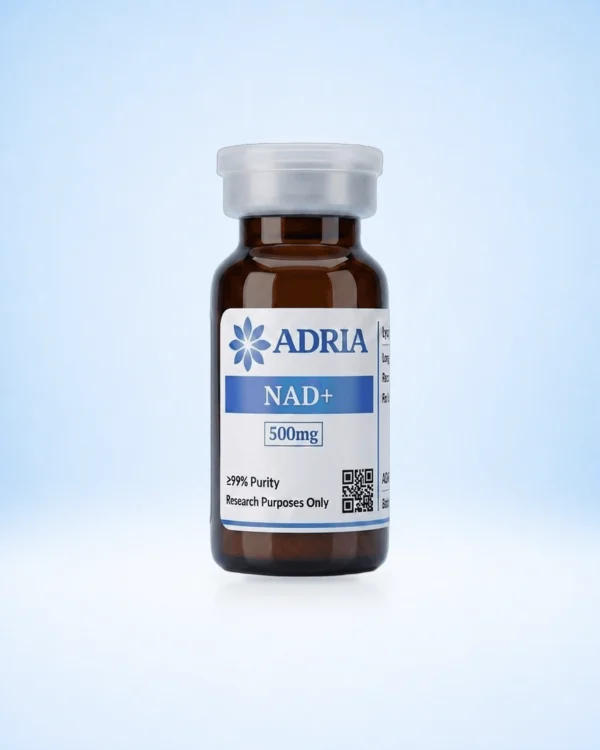
NAD+
In stock
An oxidized nicotinamide cofactor used in controlled redox, enzyme, and cellular-metabolism studies.
MassQuantity
62,50 €62,50 €
Order within — · ships today
Cutoff 10:00 · local time
Arrives Sep 21 - Sep 23
to Europe
Free shipping on orders over €150
We accept
More at checkout
NAD+ · 1 vial162,50 €62,50 €
NAD+
41,50 €–62,50 €Price range: 41,50 € through 62,50 €
NAD+ cofactor reference for redox, sirtuin, PARP, and energy-metabolism studies.
Scroll horizontally to reach every product-information tab.
Research overview
NAD+
NAD+ is the oxidized form of nicotinamide adenine dinucleotide and is a biochemical cofactor rather than a peptide. Its reversible redox chemistry allows it to participate in electron-transfer reactions and in enzyme systems that depend on nicotinamide cofactors.
The cited primary paper examines the relationship among AMPK signalling, NAD+ metabolism, and SIRT1 activity in a controlled research setting. Alongside the authoritative identity records, it provides biochemical pathway context rather than evidence of product performance; the supplied material's form, content, and lot-specific characteristics remain governed by analytical documentation.
Compound information
Specifications
Molecular profile
Molecular mass
663.43 g/mol
CAS number
53-84-9
Molecular formula
C21H27N7O14P2
Material record
Physical appearance
White to off-white powder
Solubility
Soluble in bacteriostatic water and suitable aqueous laboratory solvents.
Product note
Nicotinamide adenine dinucleotide oxidized form; supplied strictly for research use only.
Laboratory care
Handling
Product storage
Sealed dry material: store at -20 °C, dry and protected from light. Prepared solutions require a laboratory-validated stability protocol.
Material in transport
Keep the sealed container dry, protected from direct light, and within the product-specific laboratory transport conditions.
Storage of dry material
Keep the sealed reference material protected from moisture and light and follow the product-specific storage record maintained by Adria Science.
Storage of prepared laboratory solutions
Prepared laboratory solutions require compatible solvent selection, clean handling, and a documented laboratory stability policy.
Analytical documentation
Latest test results
On request
Documentation is available on request
Contact us for the current record for this strength. We never substitute a generic or mismatched certificate.
Your batch is confirmed when your order is allocated.
Latest published result
Liquilabs s.r.o.Signed Certificate of Analysis · 500mg
98.9%Purity by HPLC
Batch number
20263412
Tested
2026-06-09
Recorded QC panel
AssayPeptide screening
418 mg
PurityPeptide screening
98.9%
Identity (FTIR)FTIR spectrum
1000
Identity (RT)Retention time
0.987
These are the latest published results for this strength. The batch number is printed on each vial. Your supplied batch is confirmed against the matching published record when your order is allocated.
Koneshamoorthy A, Seniveratne-Epa D, Calder G, Sawyer M, Kay TWH, Farrell S, Loudovaris T, Mariana L, McCarthy D, Lyu R, Liu X, Thorn P, Tong J, Chin LK, Zacharin M, Trainer A, Taylor S, MacIsaac RJ, Sachithanandan N, Thomas HE, Krishnamurthy B · 2022
Case Report: Hypoglycemia Due to a Novel Activating Glucokinase Variant in an Adult - a Molecular Approach





 More at checkout