Buy 2, save 5%Buy 3+, save 9%Buy 6+, save 15%Buy 10+, save 22%Free EU & Balkan shipping over €1503rd-party tested batchesTest results available through the libraryCzech Republic fulfillmentResearch use onlyBuy 2, save 5%Buy 3+, save 9%Buy 6+, save 15%Buy 10+, save 22%Free EU & Balkan shipping over €1503rd-party tested batchesTest results available through the libraryCzech Republic fulfillmentResearch use only
Lyophilized form helps protect peptide quality. Peptides are supplied as a dry powder, which may look like a compact "puck" or a lighter powder inside the vial.
Because the peptide is dry, it does not require refrigerated shipping during normal transit, including warm seasonal conditions. For longer storage, follow the storage guidance in the product description.
Appearance can vary. The stated peptide content is checked through third-party analysis.
Read more in the product description.
Solution not bundled
Peptides are delivered as lyophilized powder. This dry form helps preserve peptide quality during storage and transport and does not require refrigerated shipping during normal transit.
To prepare a solution, use a solvent such as Bacteriostatic water. It is sold separately, so add it only when you need it for peptide preparation.
Read more in the product description.
Biochemical reference
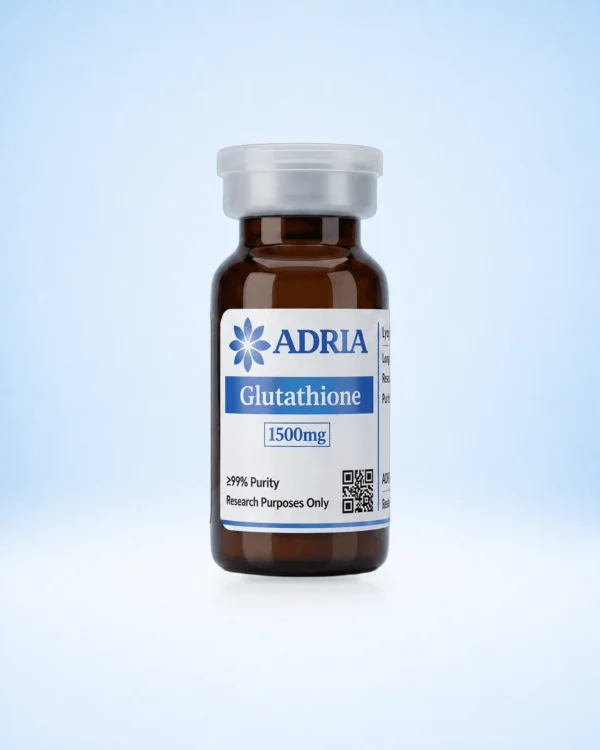
Glutathione
In stock
A reduced tripeptide reference used in redox and analytical chemistry studies.
MassQuantity
57,50 €57,50 €
Order within — · ships today
Cutoff 10:00 · local time
Arrives Sep 21 - Sep 23
to Europe
Free shipping on orders over €150
We accept
More at checkout
Glutathione · 1 vial157,50 €57,50 €
Glutathione
57,50 €
Reduced glutathione reference material for redox, thiol, and oxidative-stress models.
Scroll horizontally to reach every product-information tab.
Research overview
Glutathione
Glutathione is the tripeptide gamma-glutamyl-cysteinyl-glycine and a central cellular redox compound.
Laboratory work uses it in redox chemistry, thiol analysis, enzyme assays, and oxidative-stress models. The listed sources are a research starting point rather than a substitute for product evidence: the supplied material's exact form, lot, and measured characteristics must be established through its signed analytical record.
Compound information
Specifications
Molecular profile
Sequence
gamma-Glu-Cys-Gly
Molecular mass
307.32 g/mol
CAS number
70-18-8
Molecular formula
C10H17N3O6S
Material record
Physical appearance
White to off-white powder
Solubility
Soluble in bacteriostatic water and suitable aqueous laboratory solvents.
Product note
Tripeptide redox-system research compound; supplied strictly for research use only.
Laboratory care
Handling
Peptides in transport
Peptides in lyophilized form are supplied in glass vials by standard shipping methods and do not require refrigeration. Short-term temperature fluctuations during transport will not reduce their quality and efficacy. Even at high summer temperatures, the peptides in lyophilized form are stable for several weeks.
Storage of lyophilized peptides
Lyophilized peptides should be stored in a dry place, protected from light and moisture. The following storage conditions are generally recommended:
Room temperature (15–25 °C): Up to 3 months
Refrigerated (2–8 °C): Up to 6 months
Frozen (-20 °C or below): 3–5 years (recommended for long-term storage)
Allow the vial to reach room temperature after taking it out of the refrigerator or freezer.
Storage of reconstituted peptides
Once reconstituted, peptide solutions are generally less stable than their lyophilized form and should be stored under refrigerated conditions whenever possible.
The following storage conditions are generally recommended:
Room temperature (15–25 °C): Avoid prolonged storage
Refrigerated (2–8 °C): Typically 4–8 weeks
Frozen (-20 °C or below): Up to 3–4 months
To preserve peptide integrity, avoid repeated freeze–thaw cycles, as these may accelerate peptide degradation.
Important: Most manufacturers recommend discarding reconstituted peptides within 4 weeks when stored at 2–8 °C. This recommendation is intentionally conservative and may not reflect the actual chemical stability of every peptide. In our own stability studies, many peptides reconstituted in bacteriostatic water showed no detectable degradation after 12 weeks of refrigerated storage. As peptide stability is highly sequence- and formulation-dependent, this result should not be extrapolated to all peptides without supporting stability data.
Analytical documentation
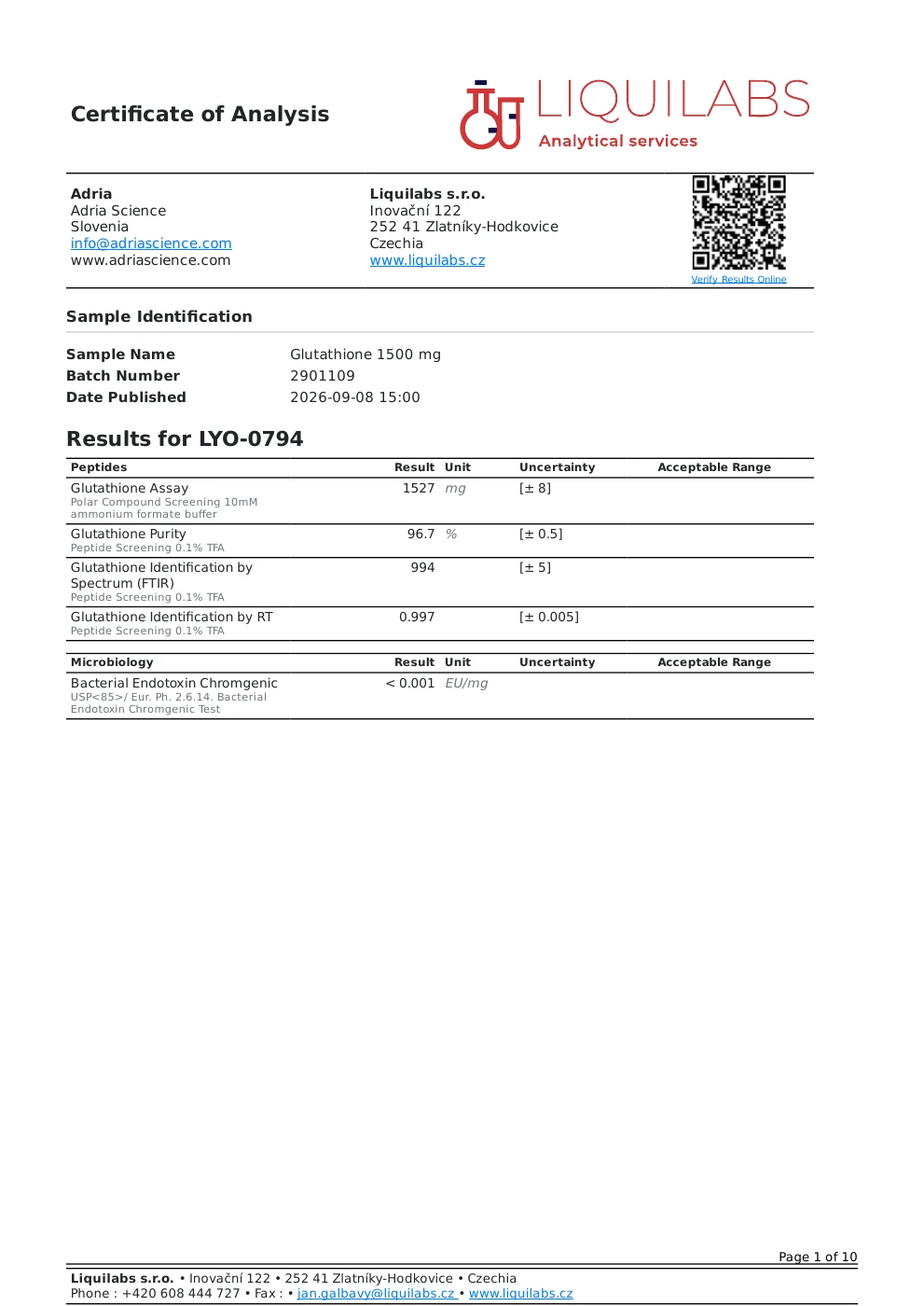
Latest test results
Latest published result
Liquilabs s.r.o.Signed Certificate of Analysis · 1500 mg
These are the latest published results for this strength. The batch number is printed on each vial. Your supplied batch is confirmed against the matching published record when your order is allocated.
Glutathione as an oral whitening agent: a randomized, double-blind, placebo-controlled study
The Journal of dermatological treatment ·
View source ↗
Søndergård SD, Cintin I, Kuhlman AB, Morville TH, Bergmann ML, Kjær LK, Poulsen HE, Giustarini D, Rossi R, Dela F, Helge JW, Larsen S · 2021
The effects of 3 weeks of oral glutathione supplementation on whole body insulin sensitivity in obese males with and without type 2 diabetes: a randomized trial
Applied physiology, nutrition, and metabolism = Physiologie appliquee, nutrition et metabolisme ·
View source ↗
Honda Y, Kessoku T, Sumida Y, Kobayashi T, Kato T, Ogawa Y, Tomeno W, Imajo K, Fujita K, Yoneda M, Kataoka K, Taguri M, Yamanaka T, Seko Y, Tanaka S, Saito S, Ono M, Oeda S, Eguchi Y, Aoi W, Sato K, Itoh Y, Nakajima A · 2017
Efficacy of glutathione for the treatment of nonalcoholic fatty liver disease: an open-label, single-arm, multicenter, pilot study





 More at checkout