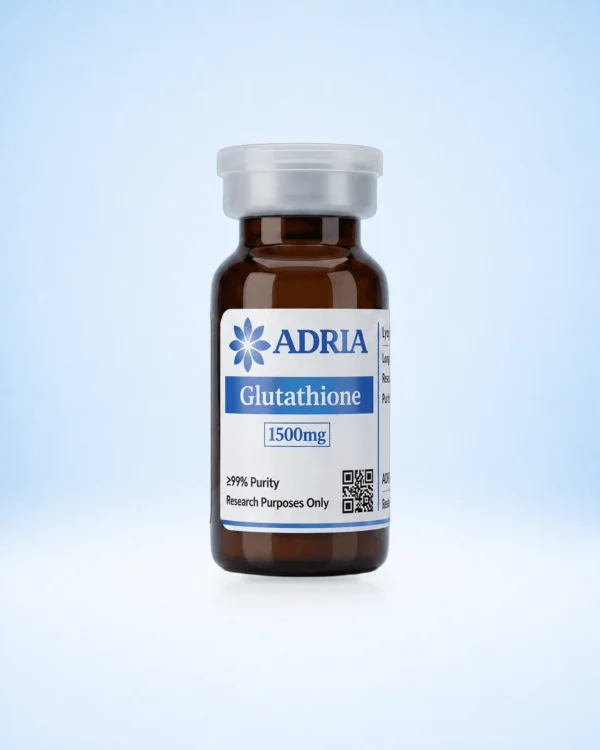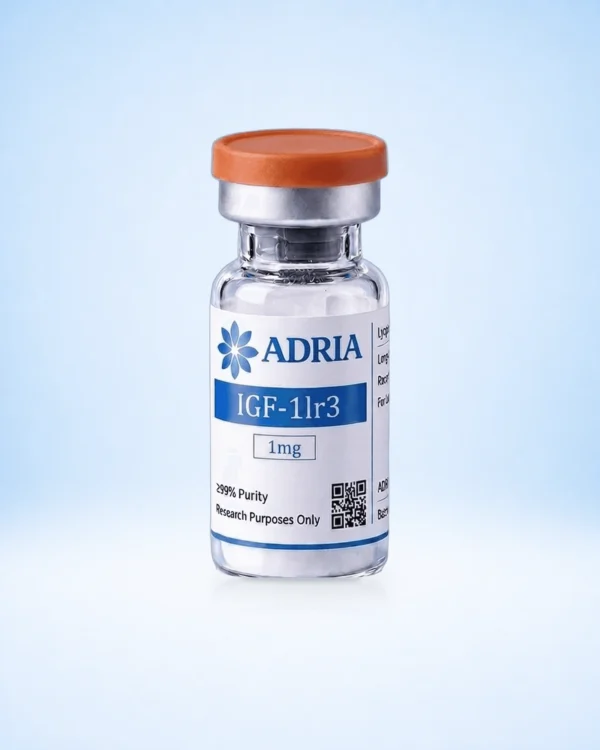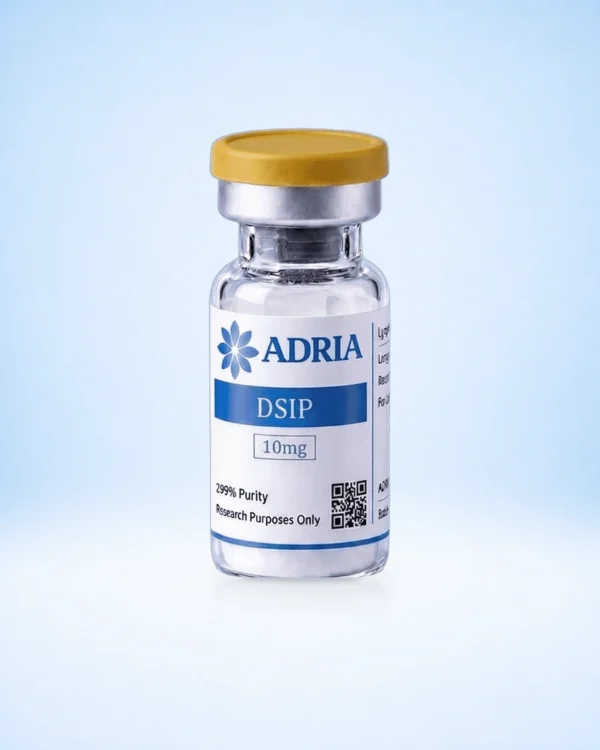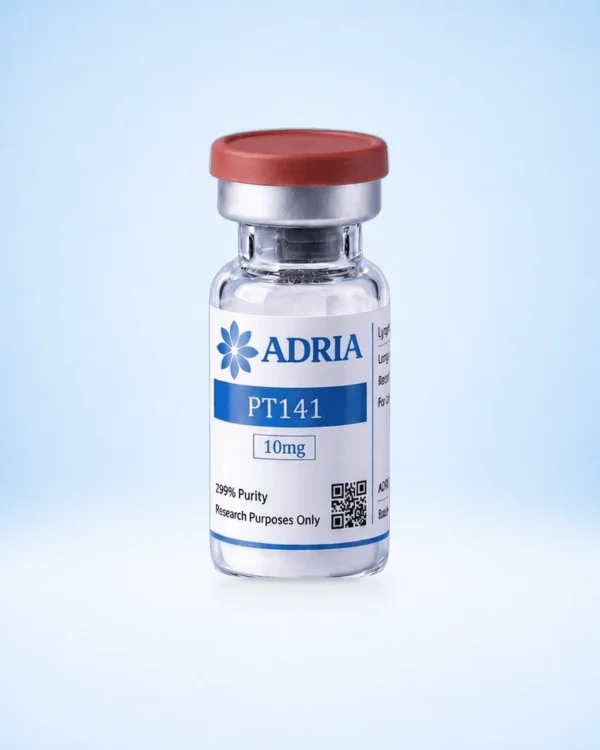
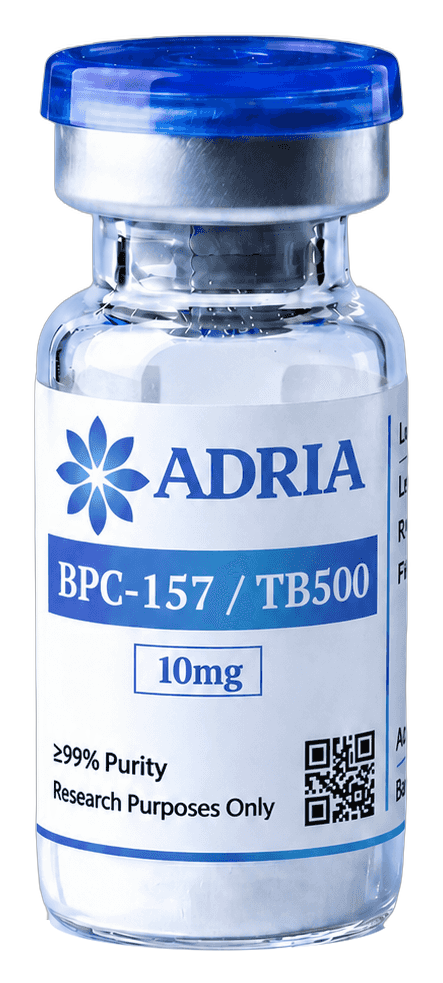
Peptide appearance
Lyophilized form helps protect peptide quality. Peptides are supplied as a dry powder, which may look like a compact "puck" or a lighter powder inside the vial.
Because the peptide is dry, it does not require refrigerated shipping during normal transit, including warm seasonal conditions. For longer storage, follow the storage guidance in the product description.
Appearance can vary. The stated peptide content is checked through third-party analysis.
Read more in the product description.
Solution not bundled
Peptides are delivered as lyophilized powder. This dry form helps preserve peptide quality during storage and transport and does not require refrigerated shipping during normal transit.
To prepare a solution, use a solvent such as Bacteriostatic water. It is sold separately, so add it only when you need it for peptide preparation.
Read more in the product description.
Tissue Biology Research
BPC-157 / TB500
Low stock
A two-component BPC-157 and TB-500 research blend with declared component amounts.
Order within — to ship today
Arrives 16 – 20 October to Europe







 Shown at checkout
BPC-157 / TB500
Price range: 83,50 € through 129,90 €
BPC-157 and TB-500 blend for paired tissue-signalling and cell-migration studies.
Research overview
BPC-157 / TB500
BPC-157 / TB500 combines two separately described peptide research materials in one vial.
The blend should be interpreted component by component for identity, sequence, and analytical documentation rather than as a new single compound. The listed sources are a research starting point rather than a substitute for product evidence: the supplied material's exact form, lot, and measured characteristics must be established through its signed analytical record.
Compound information
Specifications
Molecular profile
- Sequence
- BPC-157: Gly-Glu-Pro-Pro-Pro-Gly-Lys-Pro-Ala-Asp-Asp-Ala-Gly-Leu-Val; TB-500 (thymosin beta-4): Ac-Ser-Asp-Lys-Pro-Asp-Met-Ala-Glu-Ile-Glu-Lys-Phe-Asp-Lys-Ser-Lys-Leu-Lys-Lys-Thr-Glu-Thr-Gln-Glu-Lys-Asn-Pro-Leu-Pro-Ser-Lys-Glu-Thr-Ile-Glu-Gln-Glu-Lys-Gln-Ala-Gly-Glu-Ser-OH
- Molecular mass
- BPC-157: 1419.54 g/mol; TB-500 (thymosin beta-4): 4963.49 g/mol
- CAS number
- BPC-157: 137525-51-0; TB-500 (thymosin beta-4): 77591-33-4
- Molecular formula
- BPC-157: C62H98N16O22; TB-500 (thymosin beta-4): C212H350N56O78S
Material record
- Physical appearance
- White to off-white lyophilized powder
- Solubility
- Soluble in bacteriostatic water and suitable aqueous laboratory solvents.
- Product note
- Two-component blend containing BPC-157 and full-length thymosin beta-4; supplied strictly for research use only.
Laboratory care
Handling
Peptides in transport
Peptides in lyophilized form are supplied in glass vials by standard shipping methods and do not require refrigeration. Short-term temperature fluctuations during transport will not reduce their quality and efficacy. Even at high summer temperatures, the peptides in lyophilized form are stable for several weeks.
Storage of lyophilized peptides
Lyophilized peptides should be stored in a dry place, protected from light and moisture. The following storage conditions are generally recommended:
- Room temperature (15–25 °C): Up to 3 months
- Refrigerated (2–8 °C): Up to 6 months
- Frozen (-20 °C or below): 3–5 years (recommended for long-term storage)
Allow the vial to reach room temperature after taking it out of the refrigerator or freezer.
Storage of reconstituted peptides
Once reconstituted, peptide solutions are generally less stable than their lyophilized form and should be stored under refrigerated conditions whenever possible.
The following storage conditions are generally recommended:
- Room temperature (15–25 °C): Avoid prolonged storage
- Refrigerated (2–8 °C): Typically 4–8 weeks
- Frozen (-20 °C or below): Up to 3–4 months
To preserve peptide integrity, avoid repeated freeze–thaw cycles, as these may accelerate peptide degradation.
Important: Most manufacturers recommend discarding reconstituted peptides within 4 weeks when stored at 2–8 °C. This recommendation is intentionally conservative and may not reflect the actual chemical stability of every peptide. In our own stability studies, many peptides reconstituted in bacteriostatic water showed no detectable degradation after 12 weeks of refrigerated storage. As peptide stability is highly sequence- and formulation-dependent, this result should not be extrapolated to all peptides without supporting stability data.
Analytical documentation
Tests
Documentation is available on request
Contact us for the current record for this strength. We never substitute a generic or mismatched certificate.
Your batch is confirmed when your order is allocated.Latest published result
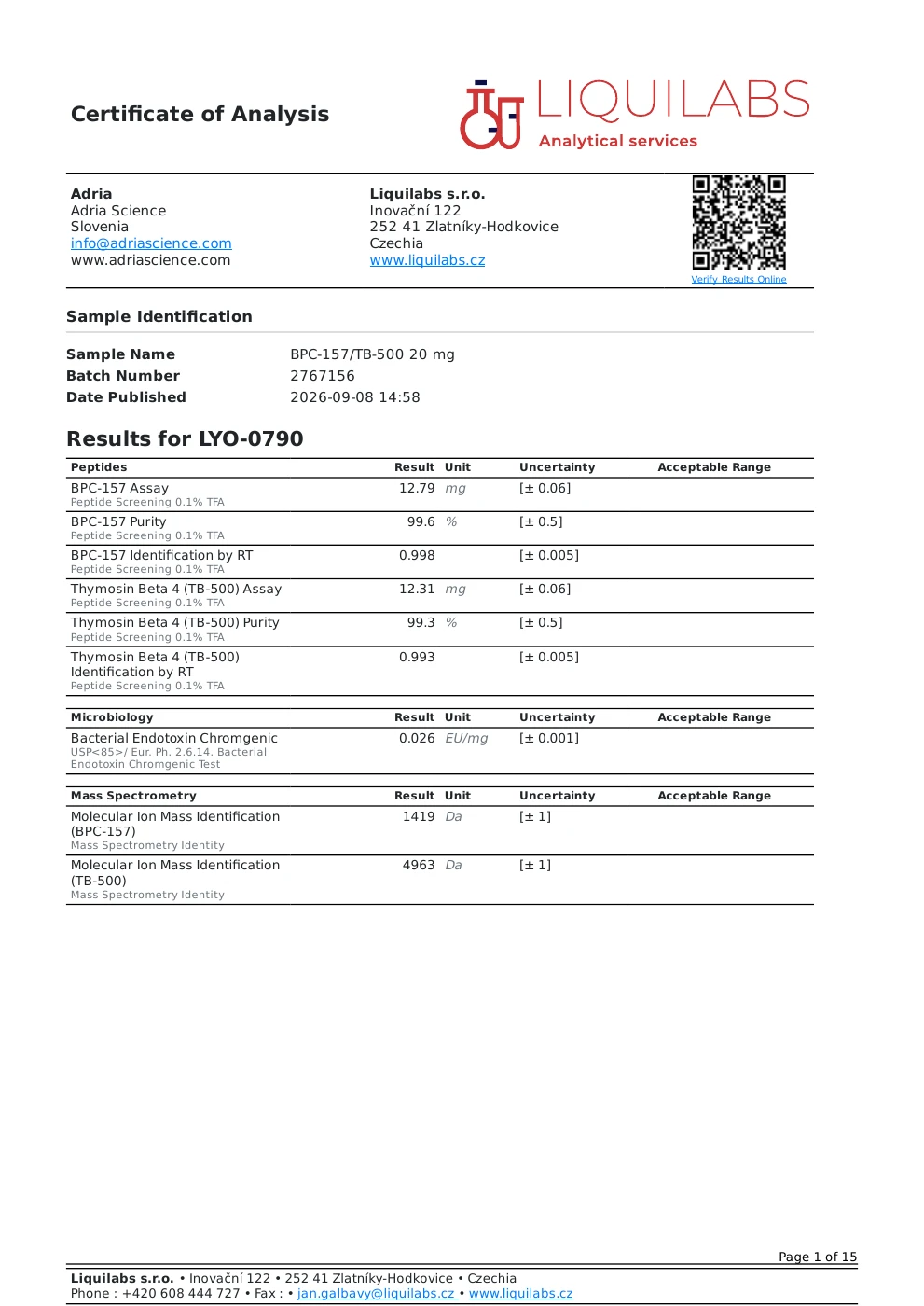
Liquilabs s.r.o.Signed Certificate of Analysis · 10mg + 10mg
See reportPurity by HPLC
Recorded QC panel
- BPC-157 assayPeptide Screening 0.1% TFA
- 12.79 mg (± 0.06 mg)
- TB-500 assayPeptide Screening 0.1% TFA
- 12.31 mg (± 0.06 mg)
- BPC-157 purityPeptide Screening 0.1% TFA
- 99.6%
- TB-500 purityPeptide Screening 0.1% TFA
- 99.3%
- BPC-157 identity (RT)Retention time
- 0.998 (± 0.005)
- TB-500 identity (RT)Retention time
- 0.993 (± 0.005)
- Bacterial endotoxinUSP 85 / Eur. Ph. 2.6.14
- 0.026 EU/mg
- BPC-157 molecular ion massMass Spectrometry Identity
- 1419 Da (± 1 Da)
- TB-500 molecular ion massMass Spectrometry Identity
- 4963 Da (± 1 Da)
These are the latest published results for this strength. The batch number is printed on each vial. Your supplied batch is confirmed against the matching published record when your order is allocated.
Source record
References
National Center for Biotechnology Information
PubChem Compound Summary: BPC-157
Identity record for the BPC-157 component.
PubChem · View source ↗National Center for Biotechnology Information
PubChem Compound Summary: Thymosin beta 4
Identity record for the thymosin-beta-4-related TB-500 component.
PubChem · View source ↗Chemical Abstracts Service
CAS Common Chemistry: 137525-51-0
Authoritative CAS Registry Number record for the BPC-157 component.
CAS Common Chemistry · View source ↗National Center for Biotechnology Information
PubChem compound record
PubChem · View source ↗Goldstein AL, Hannappel E, Sosne G, Kleinman HK · 2012
Thymosin β4: a multi-functional regenerative peptide. Basic properties and clinical applications
Expert opinion on biological therapy · View source ↗Vasireddi N, Hahamyan H, Salata MJ, Karns M, Calcei JG, Voos JE, Apostolakos JM · 2025
Emerging Use of BPC-157 in Orthopaedic Sports Medicine: A Systematic Review
HSS journal : the musculoskeletal journal of Hospital for Special Surgery · View source ↗Ruff D, Crockford D, Girardi G, Zhang Y · 2010
A randomized, placebo-controlled, single and multiple dose study of intravenous thymosin beta4 in healthy volunteers
Annals of the New York Academy of Sciences · View source ↗Malinda KM, Sidhu GS, Mani H, Banaudha K, Maheshwari RK, Goldstein AL, Kleinman HK · 1999
Thymosin beta4 accelerates wound healing
The Journal of investigative dermatology · View source ↗Xu C, Sun L, Ren F, Huang P, Tian Z, Cui J, Zhang W, Wang S, Zhang K, He L, Zhang W, Zhang C, Hao Q, Zhang Y, Li M, Li W · 2020
Preclinical safety evaluation of body protective compound-157, a potential drug for treating various wounds
Regulatory toxicology and pharmacology : RTP · View source ↗Bock-Marquette I, Saxena A, White MD, Dimaio JM, Srivastava D · 2004
Thymosin beta4 activates integrin-linked kinase and promotes cardiac cell migration, survival and cardiac repair
Nature · View source ↗· 2018
BPC-157 enhances growth hormone receptor expression in injured tendon tissueStaresinic M, Sebecic B, et al
Growth Hormone & IGF Research · View source ↗Xing Y, Ye Y, Zuo H, Li Y · 2021
Progress on the Function and Application of Thymosin β4
Frontiers in endocrinology · View source ↗Customer reviews

Sehr gut ich mag sehr.
Read full review →Super sprawnie odpowiada na nurtujące pytania obsługa na poziomie
Read full review →Reliable and fast shipping! Will order again! Kinda pricey
Read review & reply →had a communication issue with my order at first and was worried about the delay. The team got back to me and the problem was resolved. I'm satisfied with the products and happy with how it turned out in the end. Thank you for sorting it out.
Read full review →prodotti ottimi, spedizioni veloci con vari metodi di pagamento. super consigliato
Read full review →Very good products!
Read full review →Fast delivery, good product
Read full review →Excellent!
Read full review →Personale cordiale è sempre disponibile, veloci nella consegna Peccato che non c'è la possibilità di pagare con la carta
Read full review →Everything are perfect , good products , good quality , fast shipping
Read full review →Just great I’m going to buy again really soon
Read full review →Häirib see, et iga uue tellimuse juures on jälle uus pangakonto number, mida ma pean käsitsi igakord uuesti sisestama.
Read full review →Continue exploring