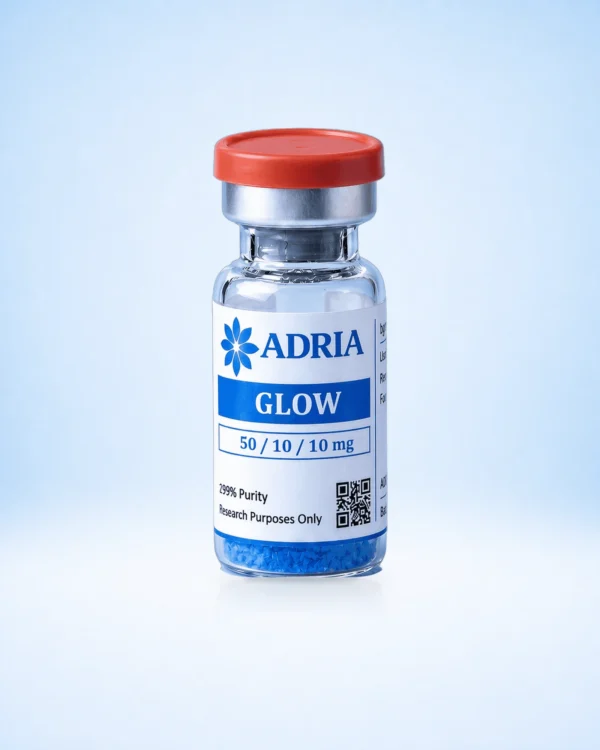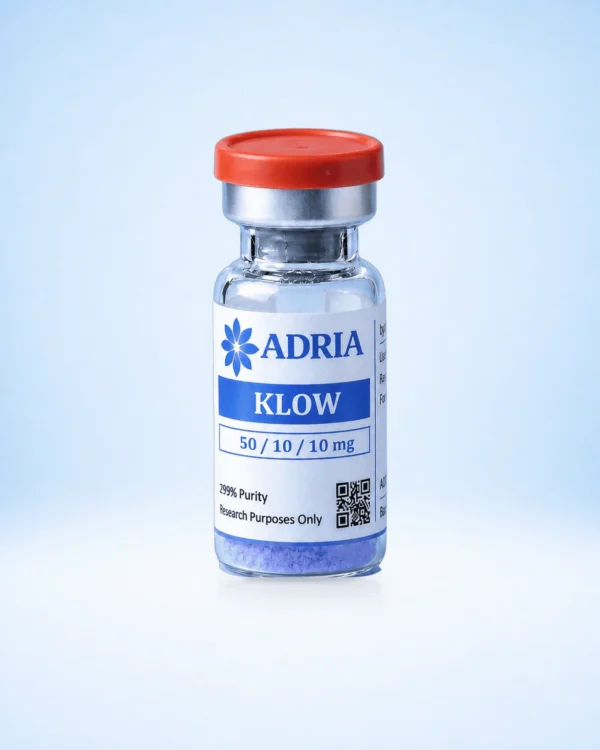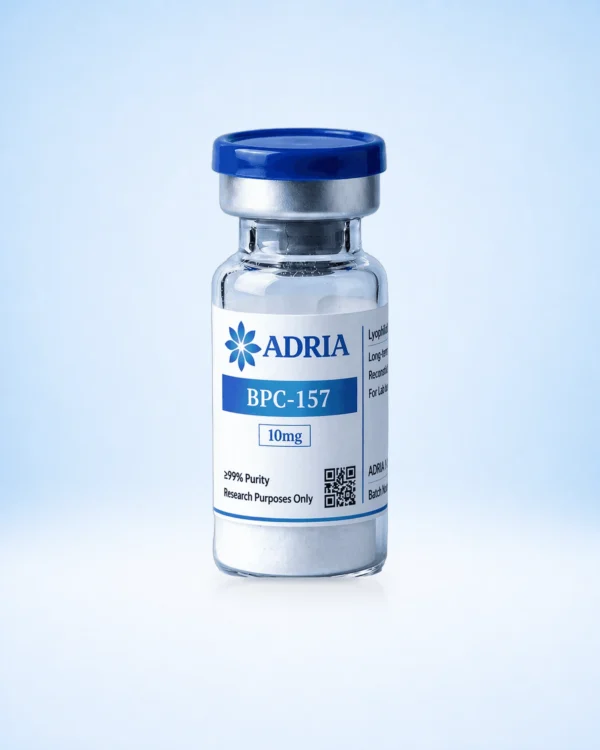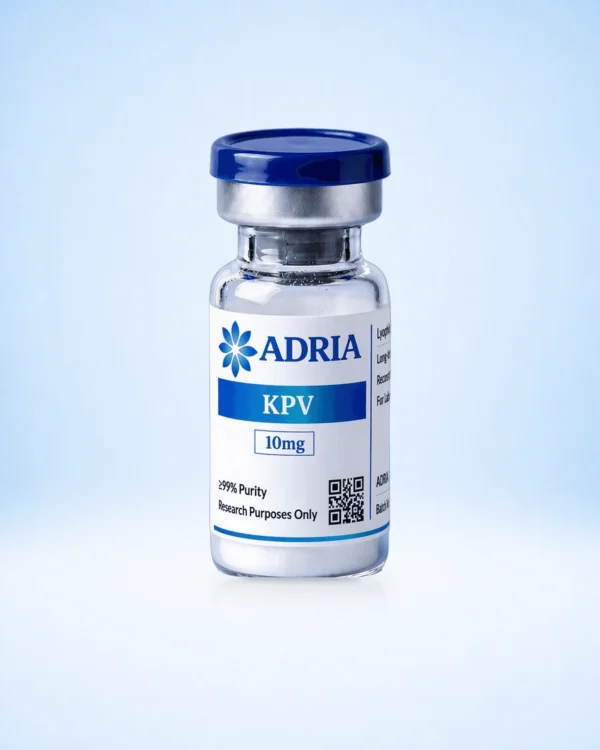
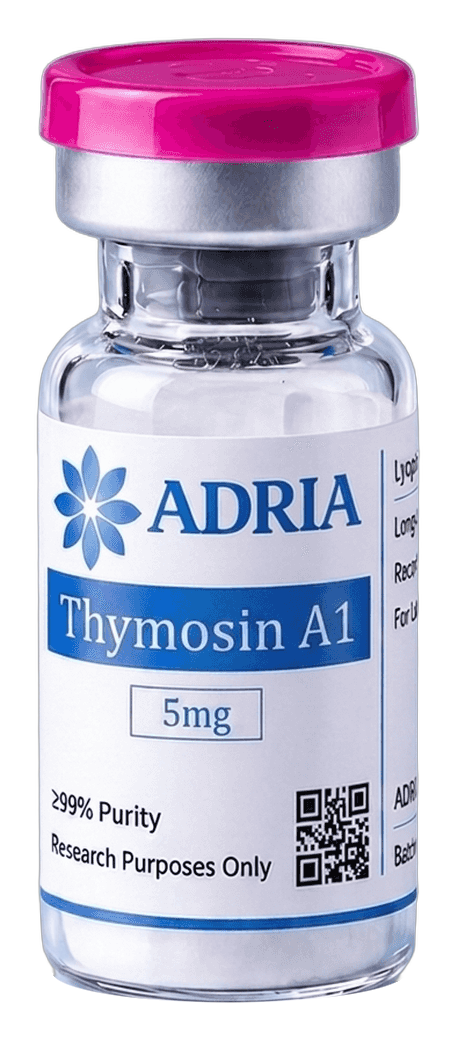
Peptide appearance
Lyophilized form helps protect peptide quality. Peptides are supplied as a dry powder, which may look like a compact "puck" or a lighter powder inside the vial.
Because the peptide is dry, it does not require refrigerated shipping during normal transit, including warm seasonal conditions. For longer storage, follow the storage guidance in the product description.
Appearance can vary. The stated peptide content is checked through third-party analysis.
Read more in the product description.
Solution not bundled
Peptides are delivered as lyophilized powder. This dry form helps preserve peptide quality during storage and transport and does not require refrigerated shipping during normal transit.
To prepare a solution, use a solvent such as Bacteriostatic water. It is sold separately, so add it only when you need it for peptide preparation.
Read more in the product description.
Thymosin peptide
Thymosin Alpha-1
In stock
Thymosin Alpha-1 is a synthetic thymosin peptide made of 28 amino acids. Published studies look at immune-cell signals, cytokines, nerve-cell models, microbial tests, and peptide synthesis.
Order within — · ships Wed, 23 Sep Cutoff 10:00 · local time
Arrives Sep 28 - Sep 30 to Europe



 More at checkout
Thymosin Alpha-1
Price range: 39,30 € through 65,30 €
Thymosin alpha peptide for immune-signalling and cytokine pathway studies.
Research overview
Thymosin Alpha-1
Thymosin Alpha-1, also called thymalfasin, has a defined thymosin-family sequence. It is different from other thymosin peptides and fragments.
Studies cover immune markers, cytokines, nerve cells, viral and microbial tests, cancer-cell models, and synthesis methods. These are experimental settings, not a promised result.
Immune-cell and cytokine research
Studies measure lymphocytes, dendritic cells, macrophages, and cytokines in controlled systems. These endpoints help researchers compare immune-signalling models.
Other work looks at pattern recognition and antigen presentation. The cell source and assay design matter in these studies.
Cellular and synthesis studies
Published work also uses nerve-cell, microbial, viral, and cancer-cell models and examines peptide-synthesis methods. Each study type should be read with its own methods and controls.
Compound information
Specifications
Molecular profile
- Sequence
- Ac-Ser-Asp-Ala-Ala-Val-Asp-Thr-Ser-Ser-Glu-Ile-Thr-Thr-Lys-Asp-Leu-Lys-Glu-Lys-Lys-Glu-Val-Val-Glu-Glu-Ala-Glu-Asn-OH
- Molecular mass
- 3108.3 g/mol
- CAS number
- 62304-98-7
- Molecular formula
- C129H215N33O55
Material record
- Physical appearance
- White to off-white lyophilized powder
- Solubility
- Soluble in bacteriostatic water and suitable aqueous laboratory solvents.
- Product note
- Synthetic 28-amino-acid thymosin alpha peptide fragment; studied for immune-signalling and cytokine pathway controlled research; supplied strictly for research use only.
Laboratory care
Handling
Peptides in transport
Peptides in lyophilized form are supplied in glass vials by standard shipping methods and do not require refrigeration. Short-term temperature fluctuations during transport will not reduce their quality and efficacy. Even at high summer temperatures, the peptides in lyophilized form are stable for several weeks.
Storage of lyophilized peptides
Lyophilized peptides should be stored in a dry place, protected from light and moisture. The following storage conditions are generally recommended:
- Room temperature (15–25 °C): Up to 3 months
- Refrigerated (2–8 °C): Up to 6 months
- Frozen (-20 °C or below): 3–5 years (recommended for long-term storage)
Allow the vial to reach room temperature after taking it out of the refrigerator or freezer.
Storage of reconstituted peptides
Once reconstituted, peptide solutions are generally less stable than their lyophilized form and should be stored under refrigerated conditions whenever possible.
The following storage conditions are generally recommended:
- Room temperature (15–25 °C): Avoid prolonged storage
- Refrigerated (2–8 °C): Typically 4–8 weeks
- Frozen (-20 °C or below): Up to 3–4 months
To preserve peptide integrity, avoid repeated freeze–thaw cycles, as these may accelerate peptide degradation.
Important: Most manufacturers recommend discarding reconstituted peptides within 4 weeks when stored at 2–8 °C. This recommendation is intentionally conservative and may not reflect the actual chemical stability of every peptide. In our own stability studies, many peptides reconstituted in bacteriostatic water showed no detectable degradation after 12 weeks of refrigerated storage. As peptide stability is highly sequence- and formulation-dependent, this result should not be extrapolated to all peptides without supporting stability data.
Analytical documentation
Tests
Documentation is available on request
Contact us for the current record for this strength. We never substitute a generic or mismatched certificate.
Your batch is confirmed when your order is allocated.Latest published result
Liquilabs s.r.o.Signed Certificate of Analysis · 10mg
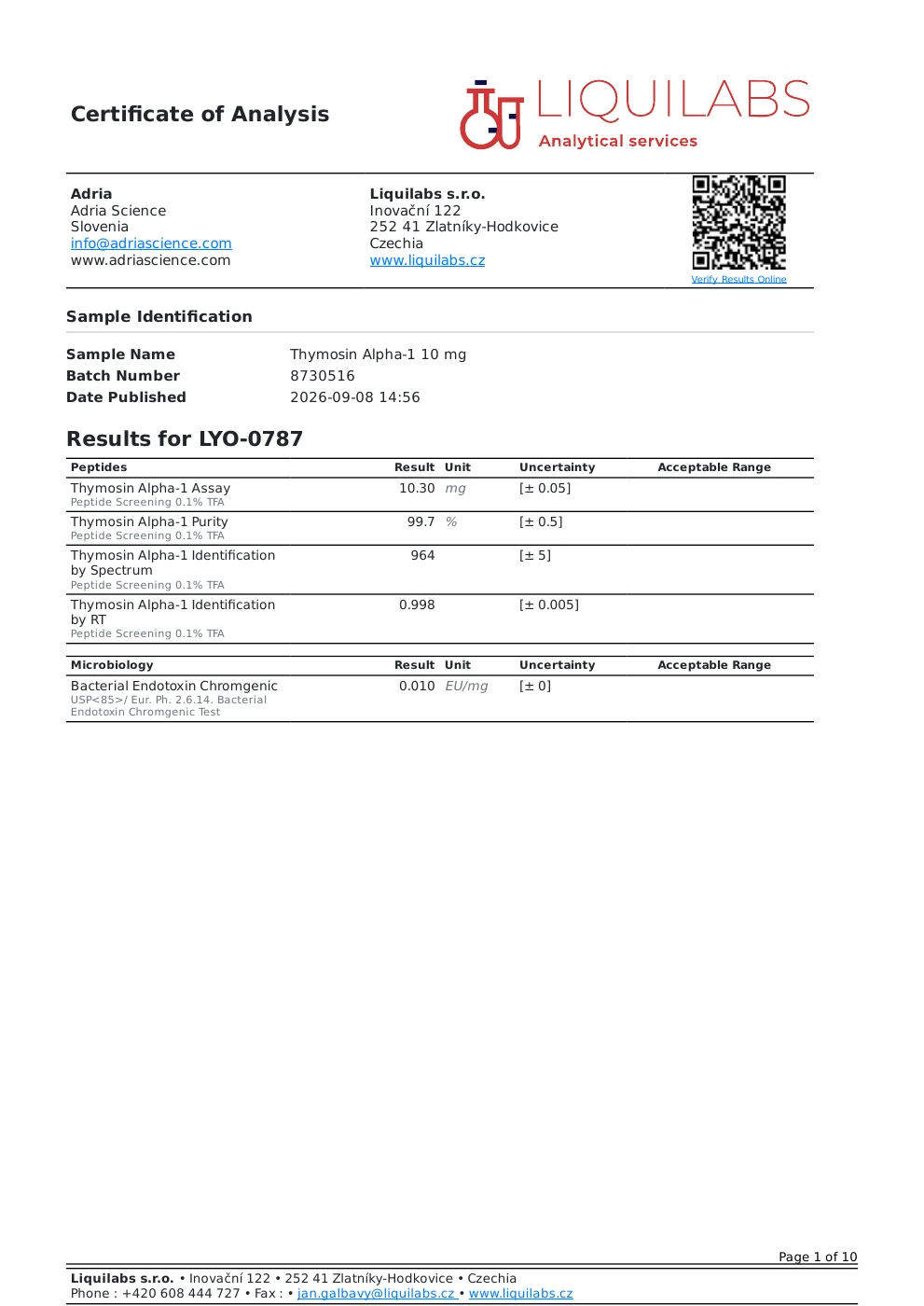
99.7%Purity by HPLC
Recorded QC panel
- AssayPeptide Screening 0.1% TFA
- 10.30 mg (± 0.05 mg)
- PurityPeptide Screening 0.1% TFA
- 99.7%
- Identity (spectrum)Peptide Screening 0.1% TFA
- 964 (± 5)
- Identity (RT)Retention time
- 0.998 (± 0.005)
- Bacterial endotoxinUSP 85 / Eur. Ph. 2.6.14
- 0.010 EU/mg
These are the latest published results for this strength. The batch number is printed on each vial. Your supplied batch is confirmed against the matching published record when your order is allocated.
Source record
References
National Center for Biotechnology Information
PubChem Compound Summary: Thymalfasin
Authoritative identity record for Thymosin Alpha-1.
PubChem · View source ↗Nevo N, et al. · 2022
Thymosin alpha 1 as an adjuvant to hyperthermic intraperitoneal chemotherapy in an experimental model of peritoneal metastases from colonic carcinoma
Primary experimental report involving thymosin alpha-1.
International Immunopharmacology · 10.1016/j.intimp.2022.109166 View source ↗Wei YT, Wang XR, Yan C, et al. · 2022
Thymosin alpha-1 Reverses M2 Polarization of Tumor-Associated Macrophages during Efferocytosis
Primary cell-signalling study involving thymosin alpha-1.
Cancer Research · 10.1158/0008-5472.can-21-4260 View source ↗National Center for Biotechnology Information
PubChem compound record
PubChem · View source ↗Dominari A, Hathaway Iii D, Pandav K, Matos W, Biswas S, Reddy G, Thevuthasan S, Khan MA, Mathew A, Makkar SS, Zaidi M, Fahem MMM, Beas R, Castaneda V, Paul T, Halpern J, Baralt D · 2020
Thymosin alpha 1: A comprehensive review of the literature
World journal of virology · View source ↗Chien RN, Liaw YF, Chen TC, Yeh CT, Sheen IS · 1998
Efficacy of thymosin alpha1 in patients with chronic hepatitis B: a randomized, controlled trial
Hepatology (Baltimore, Md.) · View source ↗King R, Tuthill C · 2016
Immune Modulation with Thymosin Alpha 1 Treatment
Vitamins and hormones · View source ↗Rost KL, Wierich W, Masayuki F, Tuthill CW, Horwitz DL, Herrmann WM · 1999
Pharmacokinetics of thymosin alpha1 after subcutaneous injection of three different formulations in healthy volunteers
International journal of clinical pharmacology and therapeutics · View source ↗C. Zhang, J. Zhou, K. Cai, W. Zhang, C. Liao, and C. Wang · 2018
Gene cloning, expression and immune adjuvant properties of the recombinant fusion peptide Tα1-BLP on avian influenza inactivate virus vaccine
Microb. Pathog ·F. Pei, X. Guan, and J. Wu · 2018
Thymosin alpha 1 treatment for patients with sepsis
Expert Opin. Biol. Ther ·G. Wang et al. · 2017
Immunopotentiator Thymosin Alpha-1 Promotes Neurogenesis and Cognition in the Developing Mouse via a Systemic Th1 Bias
Neurosci. Bull ·L. Romani et al. · 2004
Thymosin α 1 activates dendritic cells for antifungal Th1 resistance through Toll-like receptor signaling
Blood ·L. Romani et al. · 2007
Thymosin alpha1: an endogenous regulator of inflammation, immunity, and tolerance
Ann. N. Y. Acad. Sci ·A. L. Goldstein and A. L. Goldstein · 2009
From lab to bedside: emerging clinical applications of thymosin alpha 1
Expert Opin. Biol. Ther ·C. Matteucci et al. · 2017
Thymosin alpha 1 and HIV-1: recent advances and future perspectives
Future Microbiol ·C. Matteucci et al. · 2015
Thymosin α 1 potentiates the release by CD8(+) cells of soluble factors able to inhibit HIV-1 and human T lymphotropic virus 1 infection in vitro
Expert Opin. Biol. Ther ·J. Kharazmi-Khorassani, A. Asoodeh, and H. Tanzadehpanah · 2019
Antioxidant and angiotensin-converting enzyme (ACE) inhibitory activity of thymosin alpha-1 (Thα1) peptide
Bioorganic Chem ·J. Kharazmi-Khorassani and A. Asoodeh · 2019
Thymosin alpha-1; a natural peptide inhibits cellular proliferation, cell migration, the level of reactive oxygen species and promotes the activity of antioxidant enzymes in human lung epithelial adenocarcinoma cell line (A549)
Environ. Toxicol., May 2019 ·M. Maio et al. · 2010
Large randomized study of thymosin alpha 1, interferon alfa, or both in combination with dacarbazine in patients with metastatic melanoma
J. Clin. Oncol. Off. J. Am. Soc. Clin. Oncol ·R. Danielli, E. Fonsatti, L. Calabrò, A. M. Di Giacomo, and M. Maio · 2012
Thymosin α1 in melanoma: from the clinical trial setting to the daily practice and beyond
Ann. N. Y. Acad. Sci ·X. Shen et al. · 2018
Generation of a novel long-acting thymosin alpha1-Fc fusion protein and its efficacy for the inhibition of breast cancer in vivo
Biomed. Pharmacother. Biomedecine Pharmacother ·F. Wang, T. Yu, H. Zheng, and X. Lao · 2018
Thymosin Alpha1-Fc Modulates the Immune System and Down-regulates the Progression of Melanoma and Breast Cancer with a Prolonged Half-life
Sci. Rep ·Y. Xu et al. · 2019
Thymosin Alpha-1 Inhibits Complete Freund's Adjuvant-Induced Pain and Production of Microglia-Mediated Pro-inflammatory Cytokines in Spinal Cord
Neurosci. Bull., Feb. 2019 ·L. Romani et al. · 2017
Thymosin α1 represents a potential potent single-molecule-based therapy for cystic fibrosis
Nat. Med ·P. F. Day, M. Duggal, and H. Nazzal · 2019
Interventions for treating traumatised permanent front teeth: avulsed (knocked out) and replanted
Cochrane Database Syst. Rev ·M. Schmidt et al. · 2018
Design of a substrate-tailored peptiligase variant for the efficient synthesis of thymosin-α1
Org. Biomol. Chem ·Customer reviews
Continue exploring