Buy 2, save 5%Buy 3+, save 9%Buy 6+, save 15%Buy 10+, save 22%Free EU & Balkan shipping over €1503rd-party tested batchesTest results available through the libraryCzech Republic fulfillmentResearch use onlyBuy 2, save 5%Buy 3+, save 9%Buy 6+, save 15%Buy 10+, save 22%Free EU & Balkan shipping over €1503rd-party tested batchesTest results available through the libraryCzech Republic fulfillmentResearch use only
Lyophilized form helps protect peptide quality. Peptides are supplied as a dry powder, which may look like a compact "puck" or a lighter powder inside the vial.
Because the peptide is dry, it does not require refrigerated shipping during normal transit, including warm seasonal conditions. For longer storage, follow the storage guidance in the product description.
Appearance can vary. The stated peptide content is checked through third-party analysis.
Read more in the product description.
Solution not bundled
Peptides are delivered as lyophilized powder. This dry form helps preserve peptide quality during storage and transport and does not require refrigerated shipping during normal transit.
To prepare a solution, use a solvent such as Bacteriostatic water. It is sold separately, so add it only when you need it for peptide preparation.
Read more in the product description.
Cytoskeletal signalling peptide
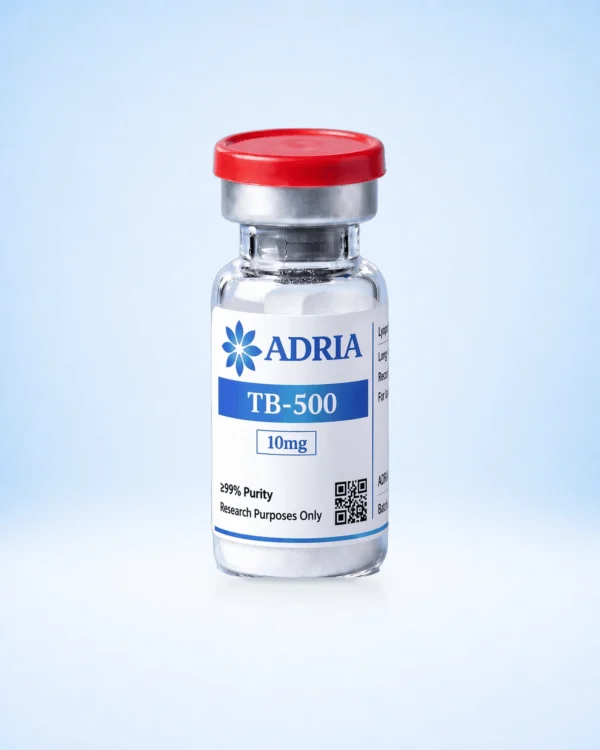
TB-500
Low stock
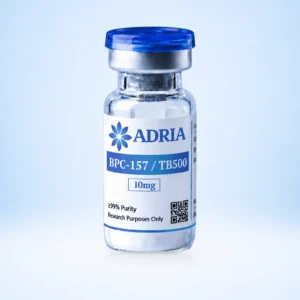
TB-500 is Adria Science's complete 43-residue thymosin beta-4 peptide. Published studies look at actin binding, cell movement, blood-vessel models, nerve research, and microbial tests.
MassQuantity
49,90 €49,90 €
Order within — · ships today
Cutoff 10:00 · local time
Arrives Sep 21 - Sep 23
to Europe
Free shipping on orders over €150
We accept
More at checkout
TB-500 · 1 vial149,90 €49,90 €
TB-500
49,90 €
Thymosin beta-4 style peptide for actin, cell-migration, and matrix studies.
Scroll horizontally to reach every product-information tab.
Research overview
TB-500
TB-500 is the complete 43-residue thymosin beta-4 sequence, not a short fragment. Its full sequence, product form, and lot results are shown in the product specifications and signed analytical records.
Studies cover full-length thymosin beta-4 in actin, vascular, nerve, microbial, and cardiovascular models. These papers provide research context, not a promised product result.
Actin organisation and cell movement
Studies identify thymosin beta-4 as an actin-binding peptide. They measure cytoskeleton organisation, cell movement, and cell development.
This work uses full-length thymosin beta-4, matching the complete 43-amino-acid identity of this Adria product.
Vascular, neural, and microbial models
Other studies use blood-vessel, nerve, cardiovascular, hair-follicle, and microbial models. These are separate research areas and should not be combined into one broad claim.
Soluble in bacteriostatic water and suitable aqueous laboratory solvents.
Product note
Full-length 43-amino-acid thymosin beta-4, identified as TB-500 in the Adria Science analytical record; supplied strictly for research use only.
Laboratory care
Handling
Peptides in transport
Peptides in lyophilized form are supplied in glass vials by standard shipping methods and do not require refrigeration. Short-term temperature fluctuations during transport will not reduce their quality and efficacy. Even at high summer temperatures, the peptides in lyophilized form are stable for several weeks.
Storage of lyophilized peptides
Lyophilized peptides should be stored in a dry place, protected from light and moisture. The following storage conditions are generally recommended:
Room temperature (15–25 °C): Up to 3 months
Refrigerated (2–8 °C): Up to 6 months
Frozen (-20 °C or below): 3–5 years (recommended for long-term storage)
Allow the vial to reach room temperature after taking it out of the refrigerator or freezer.
Storage of reconstituted peptides
Once reconstituted, peptide solutions are generally less stable than their lyophilized form and should be stored under refrigerated conditions whenever possible.
The following storage conditions are generally recommended:
Room temperature (15–25 °C): Avoid prolonged storage
Refrigerated (2–8 °C): Typically 4–8 weeks
Frozen (-20 °C or below): Up to 3–4 months
To preserve peptide integrity, avoid repeated freeze–thaw cycles, as these may accelerate peptide degradation.
Important: Most manufacturers recommend discarding reconstituted peptides within 4 weeks when stored at 2–8 °C. This recommendation is intentionally conservative and may not reflect the actual chemical stability of every peptide. In our own stability studies, many peptides reconstituted in bacteriostatic water showed no detectable degradation after 12 weeks of refrigerated storage. As peptide stability is highly sequence- and formulation-dependent, this result should not be extrapolated to all peptides without supporting stability data.
Analytical documentation
Latest test results
Latest published result
Liquilabs s.r.o.Signed Certificate of Analysis · 10mg
98.6%Purity by HPLC
Batch number
2025289
Tested
2026-05-28
Recorded QC panel
AssayPeptide screening
12.38 mg
PurityPeptide screening
98.6%
Identity (FTIR)FTIR spectrum
994
Identity (RT)Retention time
0.990
These are the latest published results for this strength. The batch number is printed on each vial. Your supplied batch is confirmed against the matching published record when your order is allocated.
Doping control analysis of TB-500, a synthetic version of an active region of thymosin beta 4, in equine urine and plasma by liquid chromatography-mass spectrometry
Primary analytical report identifying one TB-500 preparation as N-acetylated LKKTETQ; it is shown to document the identity conflict, not to assert the sold vial form.
Journal of Chromatography A · 10.1016/j.chroma.2012.09.043
View source ↗
Goldstein AL, Hannappel E, Sosne G, Kleinman HK · 2012
Thymosin β4: a multi-functional regenerative peptide. Basic properties and clinical applications
Expert opinion on biological therapy ·
View source ↗
Ruff D, Crockford D, Girardi G, Zhang Y · 2010
A randomized, placebo-controlled, single and multiple dose study of intravenous thymosin beta4 in healthy volunteers
Annals of the New York Academy of Sciences ·
View source ↗
Morris DC, Cui Y, Cheung WL, Lu M, Zhang L, Zhang ZG, Chopp M · 2014
A dose-response study of thymosin β4 for the treatment of acute stroke
Journal of the neurological sciences ·
View source ↗
Malinda KM, Sidhu GS, Mani H, Banaudha K, Maheshwari RK, Goldstein AL, Kleinman HK · 1999
Thymosin beta4 accelerates wound healing
The Journal of investigative dermatology ·
View source ↗
Xing Y, Ye Y, Zuo H, Li Y · 2021
Progress on the Function and Application of Thymosin β4
Thymosin beta 4 ophthalmic solution for dry eye: a randomized, placebo-controlled, Phase II clinical trial conducted using the controlled adverse environment (CAE™) model
Song, Ran & Choi, Hyun & Yang, Hyung-In & Yoo, Myung & Park, Yong-Beom & Kim, Kyoung. (2012). Association between serum thymosin β4 levels of rheumatoid arthritis patients and disease activity and response to therapy. Clinical rheumatology. 31. 1253-8. 10.1007/s10067-012-2011-7. [Research Gate]





 More at checkout