Buy 2, save 5%Buy 3+, save 9%Buy 6+, save 15%Buy 10+, save 22%Free EU & Balkan shipping over €1503rd-party tested batchesTest results available through the libraryCzech Republic fulfillmentResearch use onlyBuy 2, save 5%Buy 3+, save 9%Buy 6+, save 15%Buy 10+, save 22%Free EU & Balkan shipping over €1503rd-party tested batchesTest results available through the libraryCzech Republic fulfillmentResearch use only
Lyophilized form helps protect peptide quality. Peptides are supplied as a dry powder, which may look like a compact "puck" or a lighter powder inside the vial.
Because the peptide is dry, it does not require refrigerated shipping during normal transit, including warm seasonal conditions. For longer storage, follow the storage guidance in the product description.
Appearance can vary. The stated peptide content is checked through third-party analysis.
Read more in the product description.
Solution not bundled
Peptides are delivered as lyophilized powder. This dry form helps preserve peptide quality during storage and transport and does not require refrigerated shipping during normal transit.
To prepare a solution, use a solvent such as Bacteriostatic water. It is sold separately, so add it only when you need it for peptide preparation.
Read more in the product description.
GHRH analogue
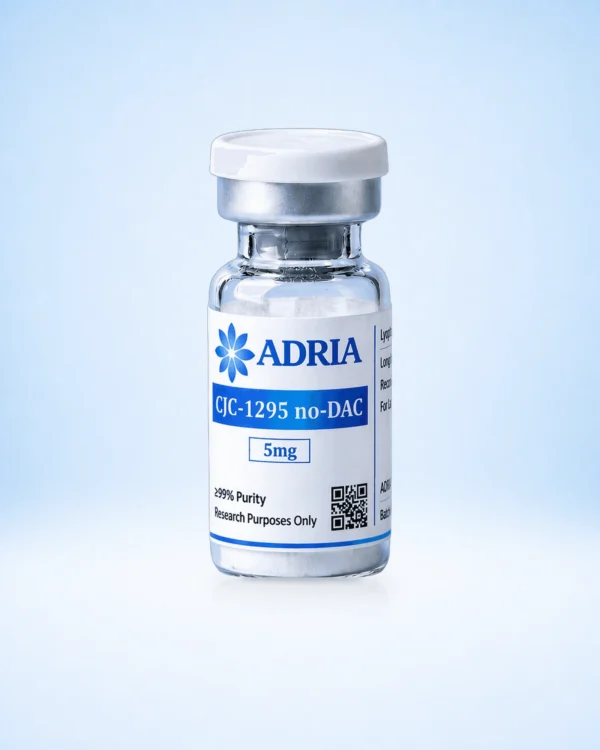
CJC - 1295 (no-DAC)
In stock
CJC-1295 no DAC, also called modified GRF(1-29), is a synthetic GHRH analogue without a drug-affinity complex. Published studies look at analogue design, VIP-receptor interaction, and growth-hormone-response measurements.
MassQuantity
80,50 €80,50 €
Order within — · ships today
Cutoff 10:00 · local time
Arrives Sep 21 - Sep 23
to Europe
Free shipping on orders over €150
We accept
More at checkout
CJC - 1295 (no-DAC) · 1 vial180,50 €80,50 €
CJC - 1295 (no-DAC)
55,50 €–80,50 €Price range: 55,50 € through 80,50 €
Modified GRF(1-29) no-DAC peptide for GHRH receptor pathway studies.
Scroll horizontally to reach every product-information tab.
Research overview
CJC - 1295 (no-DAC)
The no-DAC form is different from albumin-binding CJC-1295. Its modified GRF(1-29) sequence should be considered separately in receptor studies and analytical records.
Studies cover gastrointestinal receptors, metabolic models, and endocrine responses. These reports provide research context, not a promised product outcome.
Analogue design and receptor selectivity
Studies show how shortened GRF analogues and small amino-acid changes can affect clearance and receptor interaction. Other experiments measure VIP-receptor binding and adenylate-cyclase activity.
These comparisons show why small sequence changes can produce different laboratory readings.
Endocrine-response studies
Published work also measures growth-hormone responses in metabolic and thyroid-related models. The results belong to those study conditions, not to an individual product lot.
Soluble in bacteriostatic water and suitable aqueous laboratory solvents.
Product note
Modified GRF(1-29) / CJC-1295 without DAC; supplied strictly for research use only.
Laboratory care
Handling
Peptides in transport
Peptides in lyophilized form are supplied in glass vials by standard shipping methods and do not require refrigeration. Short-term temperature fluctuations during transport will not reduce their quality and efficacy. Even at high summer temperatures, the peptides in lyophilized form are stable for several weeks.
Storage of lyophilized peptides
Lyophilized peptides should be stored in a dry place, protected from light and moisture. The following storage conditions are generally recommended:
Room temperature (15–25 °C): Up to 3 months
Refrigerated (2–8 °C): Up to 6 months
Frozen (-20 °C or below): 3–5 years (recommended for long-term storage)
Allow the vial to reach room temperature after taking it out of the refrigerator or freezer.
Storage of reconstituted peptides
Once reconstituted, peptide solutions are generally less stable than their lyophilized form and should be stored under refrigerated conditions whenever possible.
The following storage conditions are generally recommended:
Room temperature (15–25 °C): Avoid prolonged storage
Refrigerated (2–8 °C): Typically 4–8 weeks
Frozen (-20 °C or below): Up to 3–4 months
To preserve peptide integrity, avoid repeated freeze–thaw cycles, as these may accelerate peptide degradation.
Important: Most manufacturers recommend discarding reconstituted peptides within 4 weeks when stored at 2–8 °C. This recommendation is intentionally conservative and may not reflect the actual chemical stability of every peptide. In our own stability studies, many peptides reconstituted in bacteriostatic water showed no detectable degradation after 12 weeks of refrigerated storage. As peptide stability is highly sequence- and formulation-dependent, this result should not be extrapolated to all peptides without supporting stability data.
Analytical documentation
Latest test results
Latest published result
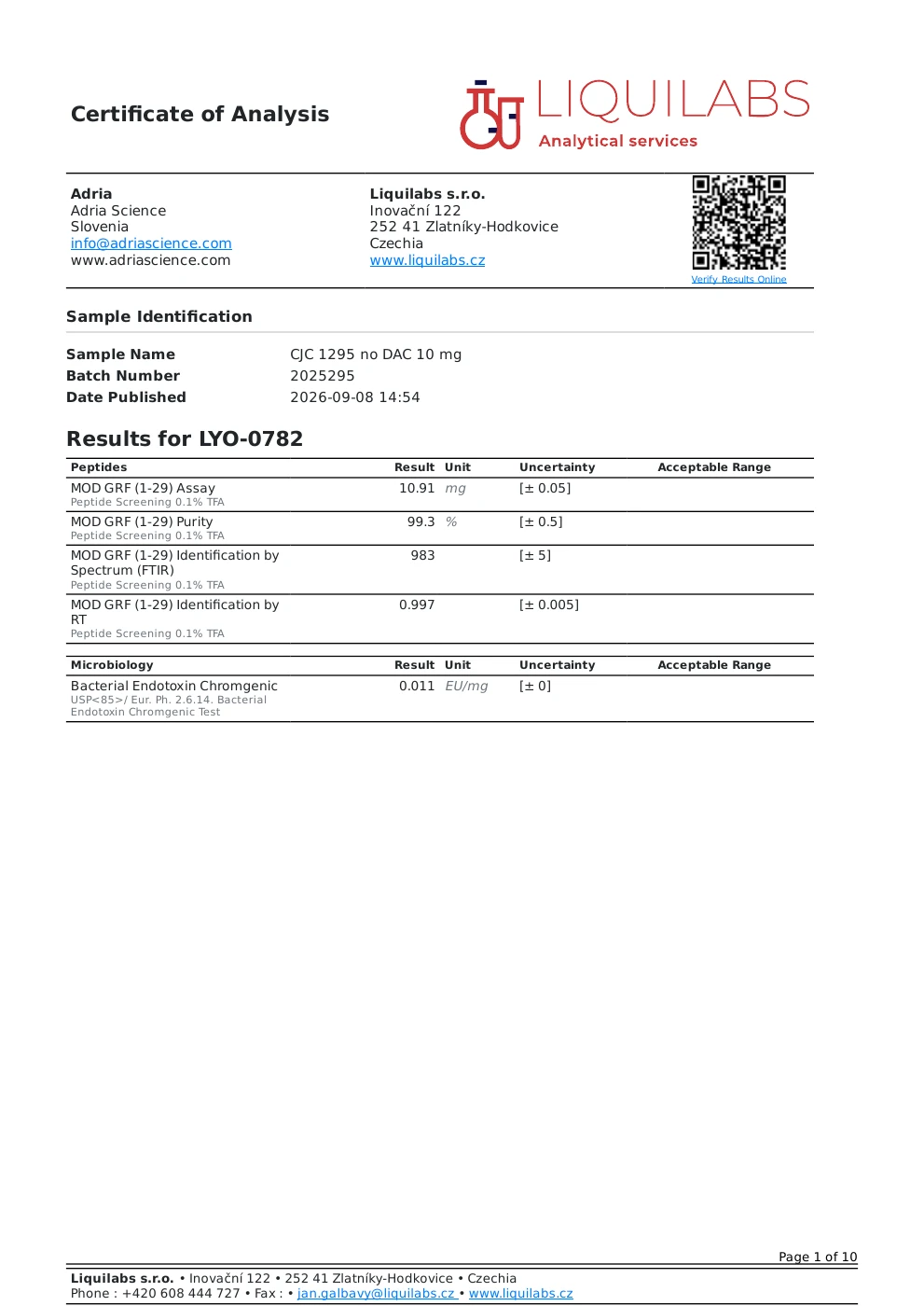
Liquilabs s.r.o.Signed Certificate of Analysis · 10mg
99.3%Purity by HPLC
Batch number
2025295
Tested
2026-09-08
Recorded QC panel
AssayPeptide Screening 0.1% TFA
10.91 mg (± 0.05 mg)
PurityPeptide Screening 0.1% TFA
99.3%
Identity (FTIR)Peptide Screening 0.1% TFA
983 (± 5)
Identity (RT)Retention time
0.997 (± 0.005)
Bacterial endotoxinUSP 85 / Eur. Ph. 2.6.14
0.011 EU/mg
These are the latest published results for this strength. The batch number is printed on each vial. Your supplied batch is confirmed against the matching published record when your order is allocated.
On request
Documentation is available on request
Contact us for the current record for this strength. We never substitute a generic or mismatched certificate.
Your batch is confirmed when your order is allocated.
Prolonged stimulation of growth hormone and insulin-like growth factor I secretion by CJC-1295, a long-acting analog of growth hormone-releasing hormone, in healthy adults
Context for long-acting DAC CJC-1295 only; this paper does not establish the identity of the sold no-DAC material.
Journal of Clinical Endocrinology and Metabolism · 10.1210/jc.2005-1536
View source ↗
Chemical Abstracts Service
CAS Common Chemistry: 446036-97-1
Authoritative CAS Registry Number record for the no-DAC CJC-1295 free-peptide form.
Sackmann-Sala L, Ding J, Frohman LA, et al. · 2009
Activation of the GH/IGF-1 axis by CJC-1295, a long-acting GHRH analog, results in serum protein profile changes in normal adult subjects
Context for long-acting DAC CJC-1295 only; this paper does not establish the identity of the sold no-DAC material.
Growth Hormone and IGF Research · 10.1016/j.ghir.2009.03.001
View source ↗
Teichman SL, Neale A, Lawrence B, Gagnon C, Castaigne JP, Frohman LA · 2006
Prolonged stimulation of growth hormone (GH) and insulin-like growth factor I secretion by CJC-1295, a long-acting analog of GH-releasing hormone, in healthy adults
The Journal of clinical endocrinology and metabolism ·
View source ↗
Raun K, Hansen BS, Johansen NL, Thøgersen H, Madsen K, Ankersen M, Andersen PH · 1998
Ipamorelin, the first selective growth hormone secretagogue
Clinical and biological features in the prognosis of adrenocortical cancer: poor outcome of cortisol-secreting tumors in a series of 202 consecutive patients
The Journal of clinical endocrinology and metabolism ·
View source ↗
T. Ito et al. · 2001
GI side-effects of a possible therapeutic GRF analogue in monkeys are likely due to VIP receptor agonist activity
Peptides ·
M. Waelbroeck, P. Robberecht, D. H. Coy, J.-C. Camus, P. D. Neef, and J. Christophe · 1985
Interaction of Growth Hormone-Releasing Factor (GRF) and 14 GRF Analogs with Vasoactive Intestinal Peptide (VIP) Receptors of Rat Pancreas. Discovery of (N-Ac-Tyr1,D-Phe2)-GRF(l-29)-NH2 as a VIP Antagonist
Endocrinology ·
A. V. Schally, X. Zhang, R. Cai, J. M. Hare, R. Granata, and M. Bartoli
Actions and potential therapeutic applications of growth hormone-releasing hormone agonists
Endocrinology ·
R. Valcavi et al. · 1986
Growth Hormone Responses to Grf 1–29 in Patients with Primary Hypothyroidism Before and During Replacement Therapy with Thyroxine





 More at checkout