Mitochondrial and cellular research tools
Peptide Tools for the Autophagy Pathway: Atg8, LC3, and GABARAP Research
A cautious autophagy article focused on Atg8-family proteins, ankyrin-derived inhibitory peptides, LC3/GABARAP selectivity, and structural-biology limits.
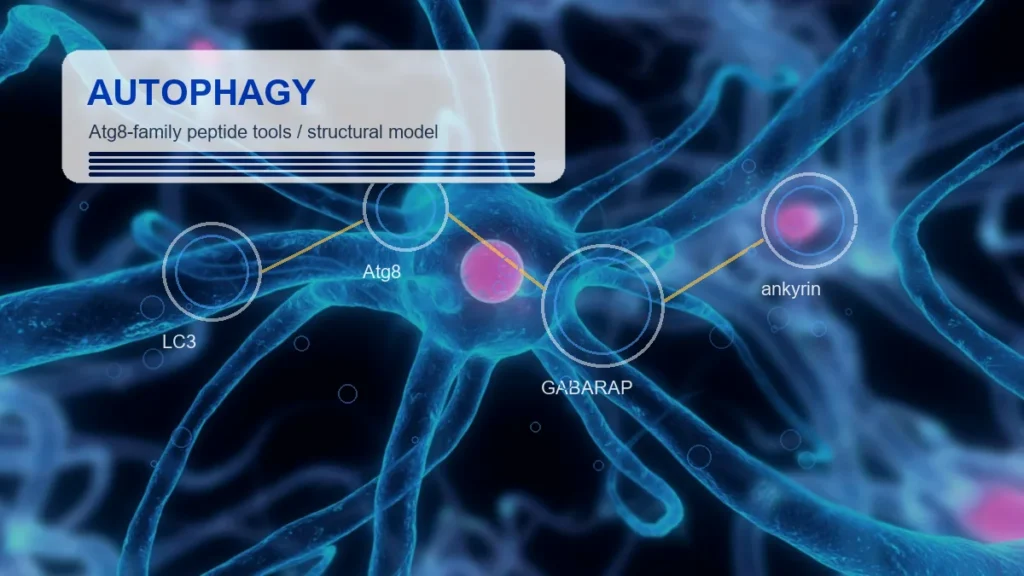
The autophagy topic should be kept as cell-biology tool research, not a disease or intervention article.
Research context
Atg8-family proteins, including LC3 and GABARAP members, are central to autophagy research. The 2018 giant-ankyrin peptide work is useful because it describes selective and high-affinity Atg8-targeting peptide tools with structural data.
The right Adria framing is Atg8-family binding, LC3/GABARAP selectivity, LIR/AIM motif context, structural biology, cell-culture tool use, and assay interpretation.
Adria research-use note
This article is a literature overview for lawful research settings only and should not be read as practical, consumer, or applied-use guidance.
How to read this research
Autophagy peptide-tool papers should be separated into Atg8-family binding, LC3/GABARAP selectivity, LIR/AIM motif context, structural model, and cell-culture tool readout.
This makes the article more useful because it frames the peptides as research tools for pathway dissection, not broad intervention claims.
Evidence checkpoints for this topic
Peptide Tools for the Autophagy Pathway is most useful in the archive when it is read through sequence identity, receptor or gene-expression context, neurotrophin or stress-marker endpoints, and model limits. A stronger article does not only name a peptide or pathway; it explains what kind of evidence the source actually provides and what remains outside the source.
In this article, sources such as Atg8-targeting inhibitory peptides from giant ankyrins, Nature Chemical Biology DOI for the Atg8 peptide study, Autophagy genes review should be read for their specific methods, endpoints, and limits. That makes the article more useful for a research archive because a reader can see whether a statement comes from a primary experiment, a review, a mechanistic assay, or a documentation-style discussion.
- Model: check whether the source uses receptor signaling, transcription endpoints, peptide-fragment identity, stress-marker work, or behavioral model context.
- Endpoint: record BDNF, NGF, Trk-family markers, GABAergic gene-expression signals, melanocortin receptor activity, or other measured pathway markers.
- Comparator: verify the reference peptide, receptor subtype, timepoint, model condition, and whether the paper reports direct or downstream markers.
- Documentation: keep sequence identity, batch traceability, COA context, storage condition, and source link together.
- Limit: keep visible why neuroactive or melanocortin language should stay tied to the exact endpoint measured.
What a careful reader can take from it
The practical value of this post is the structure it gives to the literature. Instead of treating every source as equal, the reader can separate the question being asked, the method used to ask it, and the claim that can reasonably follow. That is especially important in peptide topics, where online summaries often compress receptor data, model endpoints, supplier documentation, and broad interpretation into one sentence.
For Adria, the useful standard is simple: every strong sentence should be traceable to a source, every source should be described by its model and endpoint, and product-adjacent language should point back to analytical documentation rather than unsupported claims. This is why the article keeps PubMed, PMC, DOI, or documentation links visible instead of hiding the evidence trail.