Copper and matrix-material research
GHK-Cu in Research: Copper-Binding Peptides, Matrix Models, and Documentation Limits
A compliant research overview of GHK-Cu, focused on copper-binding peptide literature, extracellular matrix models, gene-data reviews, and documentation limits.
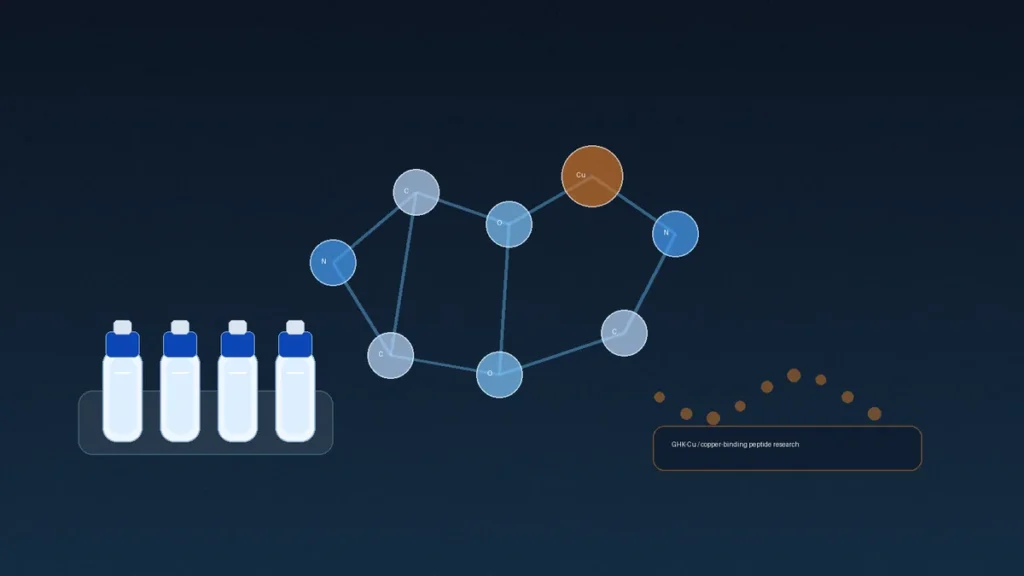
This article frames GHK-Cu in Research: Copper-Binding Peptides, Matrix Models, and Documentation Limits as a research-use literature topic, focusing on model systems, measured endpoints, documentation context, and evidence limits.
What the research literature covers
Older studies examined tripeptide-copper complexes in wound and fibroblast models. Other work looked at glycosaminoglycans and small proteoglycans in wounds, while later reviews discussed GHK as a modulator of multiple cellular pathways and considered gene-data perspectives. A recent paper on nanoengineered self-assembling peptides also highlights an important technical point: peptide activity and stability can be constrained by proteolytic cleavage and formulation context.
That body of literature makes GHK-Cu interesting for extracellular matrix, copper-complex, fibroblast, and peptide-stability research. It does not justify claims about wrinkles, hair growth, rejuvenation, applied-use, or personal outcomes on an Adria research-use-only page.
Documentation points
For GHK-Cu and similar peptide complexes, useful documentation includes identity, batch number, purity profile, storage guidance, and where relevant, salt or complex information. The COA should remain connected to the exact batch used in the study record.
Adria research-use note
GHK-Cu is discussed here only as a controlled research topic. Adria Peptides materials are not intended for human use, animal use, cosmetic use, supplement use, or therapeutic use.
Evidence checkpoints for this topic
GHK is most useful in the archive when it is read through analytical documentation, peptide identity, storage, formulation, purification, and traceability. A stronger article does not only name a peptide or pathway; it explains what kind of evidence the source actually provides and what remains outside the source.
In this article, sources such as Effect of tripeptide-copper complexes on wound and fibroblast models, Glycosaminoglycans and small proteoglycans in wounds with GHK-Cu modulation, GHK peptide as a natural modulator of multiple cellular pathways should be read for their specific methods, endpoints, and limits. That makes the article more useful for a research archive because a reader can see whether a statement comes from a primary experiment, a review, a mechanistic assay, or a documentation-style discussion.
- Model: check the material record: sequence, batch number, analytical method, storage condition, excipient context, and handling window.
- Endpoint: record identity confirmation, purity profile, HPLC/LC-MS style documentation, formulation notes, stability risk, and chain-of-custody records.
- Comparator: verify whether a statement is based on supplier documentation, analytical method, shipping condition, or a literature source.
- Documentation: keep sequence identity, batch traceability, COA context, storage condition, and source link together.
- Limit: keep visible why procurement and documentation articles should be operationally specific instead of promotional.
What a careful reader can take from it
The practical value of this post is the structure it gives to the literature. Instead of treating every source as equal, the reader can separate the question being asked, the method used to ask it, and the claim that can reasonably follow. That is especially important in peptide topics, where online summaries often compress receptor data, model endpoints, supplier documentation, and broad interpretation into one sentence.
For Adria, the useful standard is simple: every strong sentence should be traceable to a source, every source should be described by its model and endpoint, and product-adjacent language should point back to analytical documentation rather than unsupported claims. This is why the article keeps PubMed, PMC, DOI, or documentation links visible instead of hiding the evidence trail.
Sources
- Effect of tripeptide-copper complexes on wound and fibroblast models
- Glycosaminoglycans and small proteoglycans in wounds with GHK-Cu modulation
- GHK peptide as a natural modulator of multiple cellular pathways
- Regenerative and protective actions of GHK-Cu in light of gene data
- Nanoengineered peptides, proteolytic stability, and wound-model research