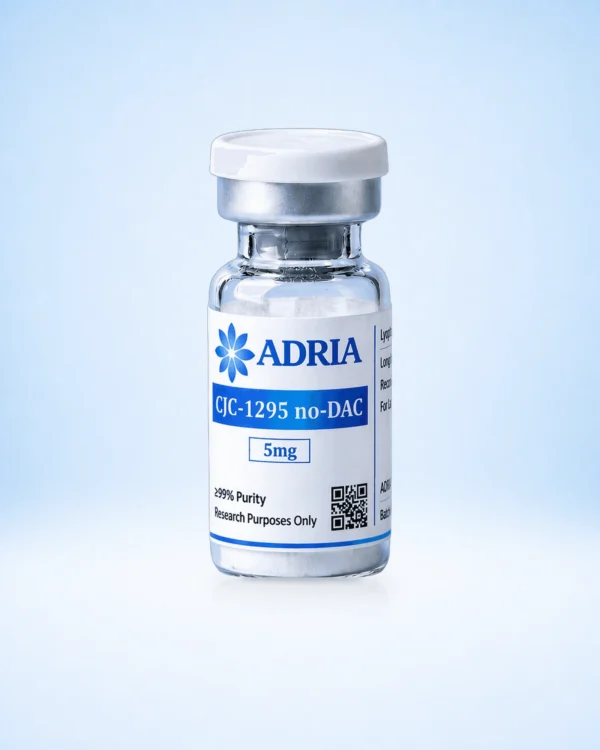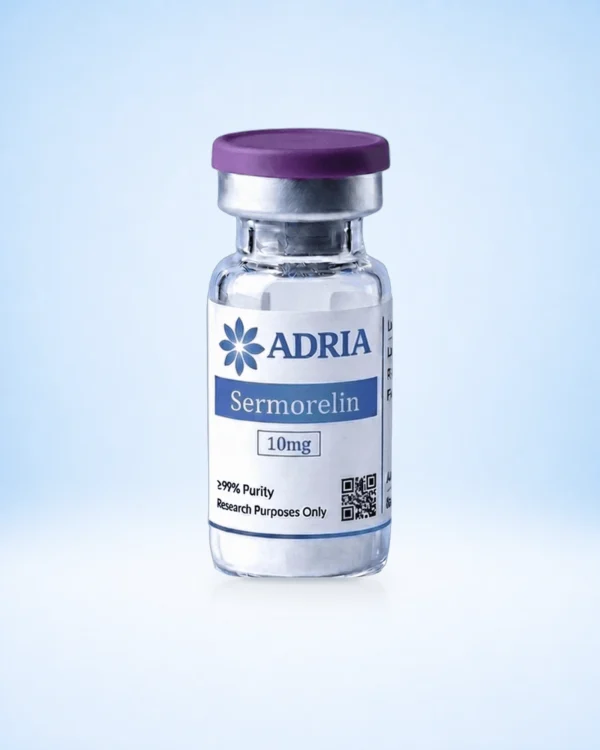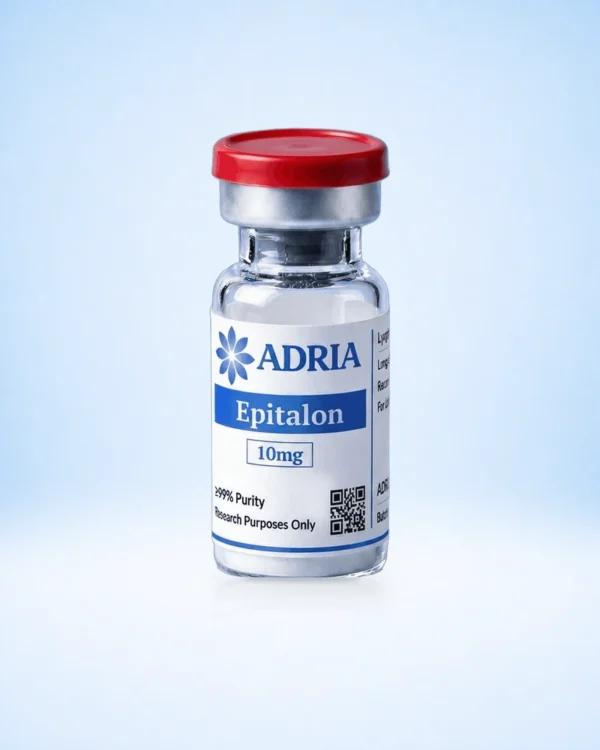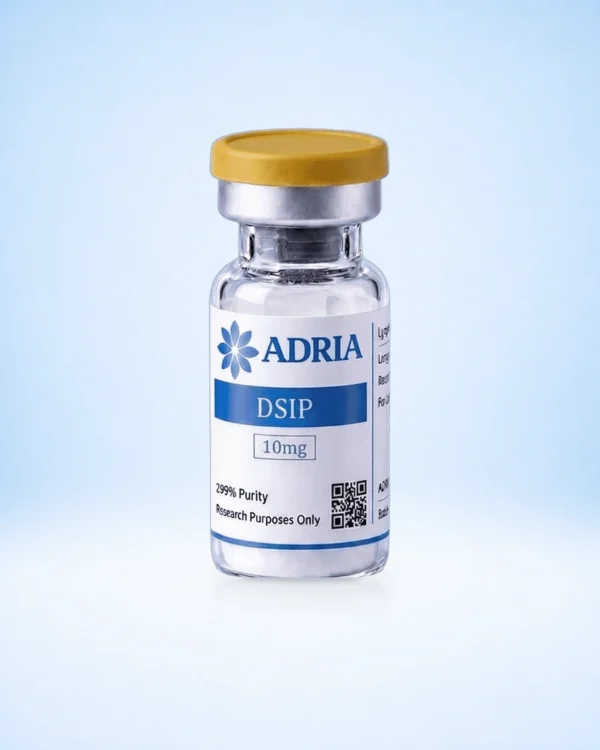

Peptide appearance
Lyophilized form helps protect peptide quality. Peptides are supplied as a dry powder, which may look like a compact "puck" or a lighter powder inside the vial.
Because the peptide is dry, it does not require refrigerated shipping during normal transit, including warm seasonal conditions. For longer storage, follow the storage guidance in the product description.
Appearance can vary. The stated peptide content is checked through third-party analysis.
Read more in the product description.
Solution not bundled
Peptides are delivered as lyophilized powder. This dry form helps preserve peptide quality during storage and transport and does not require refrigerated shipping during normal transit.
To prepare a solution, use a solvent such as Bacteriostatic water. It is sold separately, so add it only when you need it for peptide preparation.
Read more in the product description.
Cellular Biology Research
Glutathione
Low stock
A reduced tripeptide reference used in redox and analytical chemistry studies.
Order within — to ship today Until 10:00 Slovenia time (UTC+2)
Arrives 12 – 14 October to Europe







 Shown at checkout
Glutathione
57,50 €
Reduced glutathione reference material for redox, thiol, and oxidative-stress models.
Research overview
Glutathione
Glutathione is the tripeptide gamma-glutamyl-cysteinyl-glycine and a central cellular redox compound.
Laboratory work uses it in redox chemistry, thiol analysis, enzyme assays, and oxidative-stress models. The listed sources are a research starting point rather than a substitute for product evidence: the supplied material's exact form, lot, and measured characteristics must be established through its signed analytical record.
Compound information
Specifications
Molecular profile
- Sequence
- gamma-Glu-Cys-Gly
- Molecular mass
- 307.32 g/mol
- CAS number
- 70-18-8
- Molecular formula
- C10H17N3O6S
Material record
- Physical appearance
- White to off-white powder
- Solubility
- Soluble in bacteriostatic water and suitable aqueous laboratory solvents.
- Product note
- Tripeptide redox-system research compound; supplied strictly for research use only.
Laboratory care
Handling
Peptides in transport
Peptides in lyophilized form are supplied in glass vials by standard shipping methods and do not require refrigeration. Short-term temperature fluctuations during transport will not reduce their quality and efficacy. Even at high summer temperatures, the peptides in lyophilized form are stable for several weeks.
Storage of lyophilized peptides
Lyophilized peptides should be stored in a dry place, protected from light and moisture. The following storage conditions are generally recommended:
- Room temperature (15–25 °C): Up to 3 months
- Refrigerated (2–8 °C): Up to 6 months
- Frozen (-20 °C or below): 3–5 years (recommended for long-term storage)
Allow the vial to reach room temperature after taking it out of the refrigerator or freezer.
Storage of reconstituted peptides
Once reconstituted, peptide solutions are generally less stable than their lyophilized form and should be stored under refrigerated conditions whenever possible.
The following storage conditions are generally recommended:
- Room temperature (15–25 °C): Avoid prolonged storage
- Refrigerated (2–8 °C): Typically 4–8 weeks
- Frozen (-20 °C or below): Up to 3–4 months
To preserve peptide integrity, avoid repeated freeze–thaw cycles, as these may accelerate peptide degradation.
Important: Most manufacturers recommend discarding reconstituted peptides within 4 weeks when stored at 2–8 °C. This recommendation is intentionally conservative and may not reflect the actual chemical stability of every peptide. In our own stability studies, many peptides reconstituted in bacteriostatic water showed no detectable degradation after 12 weeks of refrigerated storage. As peptide stability is highly sequence- and formulation-dependent, this result should not be extrapolated to all peptides without supporting stability data.
Analytical documentation
Tests
Documentation is available on request
Contact us for the current record for this strength. We never substitute a generic or mismatched certificate.
Your batch is confirmed when your order is allocated.Source record
References
National Center for Biotechnology Information
PubChem Compound Summary: Glutathione
Authoritative identity record for reduced glutathione.
PubChem · View source ↗Chemical Abstracts Service
CAS Common Chemistry: 70-18-8
Authoritative CAS Registry Number record for glutathione.
CAS Common Chemistry · View source ↗Ngamchuea K, Batchelor-McAuley C, Compton RG · 2016
The Copper(II)-Catalyzed Oxidation of Glutathione
Primary chemical study of glutathione oxidation kinetics and mechanism.
Chemistry - A European Journal · 10.1002/chem.201603366 View source ↗Richie JP Jr, Nichenametla S, Neidig W, Calcagnotto A, Haley JS, Schell TD, Muscat JE · 2015
Randomized controlled trial of oral glutathione supplementation on body stores of glutathione
European journal of nutrition · View source ↗Arjinpathana N, Asawanonda P · 2012
Glutathione as an oral whitening agent: a randomized, double-blind, placebo-controlled study
The Journal of dermatological treatment · View source ↗Søndergård SD, Cintin I, Kuhlman AB, Morville TH, Bergmann ML, Kjær LK, Poulsen HE, Giustarini D, Rossi R, Dela F, Helge JW, Larsen S · 2021
The effects of 3 weeks of oral glutathione supplementation on whole body insulin sensitivity in obese males with and without type 2 diabetes: a randomized trial
Applied physiology, nutrition, and metabolism = Physiologie appliquee, nutrition et metabolisme · View source ↗Honda Y, Kessoku T, Sumida Y, Kobayashi T, Kato T, Ogawa Y, Tomeno W, Imajo K, Fujita K, Yoneda M, Kataoka K, Taguri M, Yamanaka T, Seko Y, Tanaka S, Saito S, Ono M, Oeda S, Eguchi Y, Aoi W, Sato K, Itoh Y, Nakajima A · 2017
Efficacy of glutathione for the treatment of nonalcoholic fatty liver disease: an open-label, single-arm, multicenter, pilot study
BMC gastroenterology · View source ↗Natarajan K, Yin G, Berk BC · 2004
Scaffolds direct Src-specific signaling in response to angiotensin II: new roles for Cas and GIT1
Molecular pharmacology · View source ↗Torpdahl M, Sørensen G, Ethelberg S, Sandø G, Gammelgard K, Jannok Porsbo L · 2006
A regional outbreak of S. Typhimurium in Denmark and identification of the source using MLVA typing
Euro surveillance : bulletin Europeen sur les maladies transmissibles = European communicable disease bulletin · View source ↗Customer reviews
Continue exploring