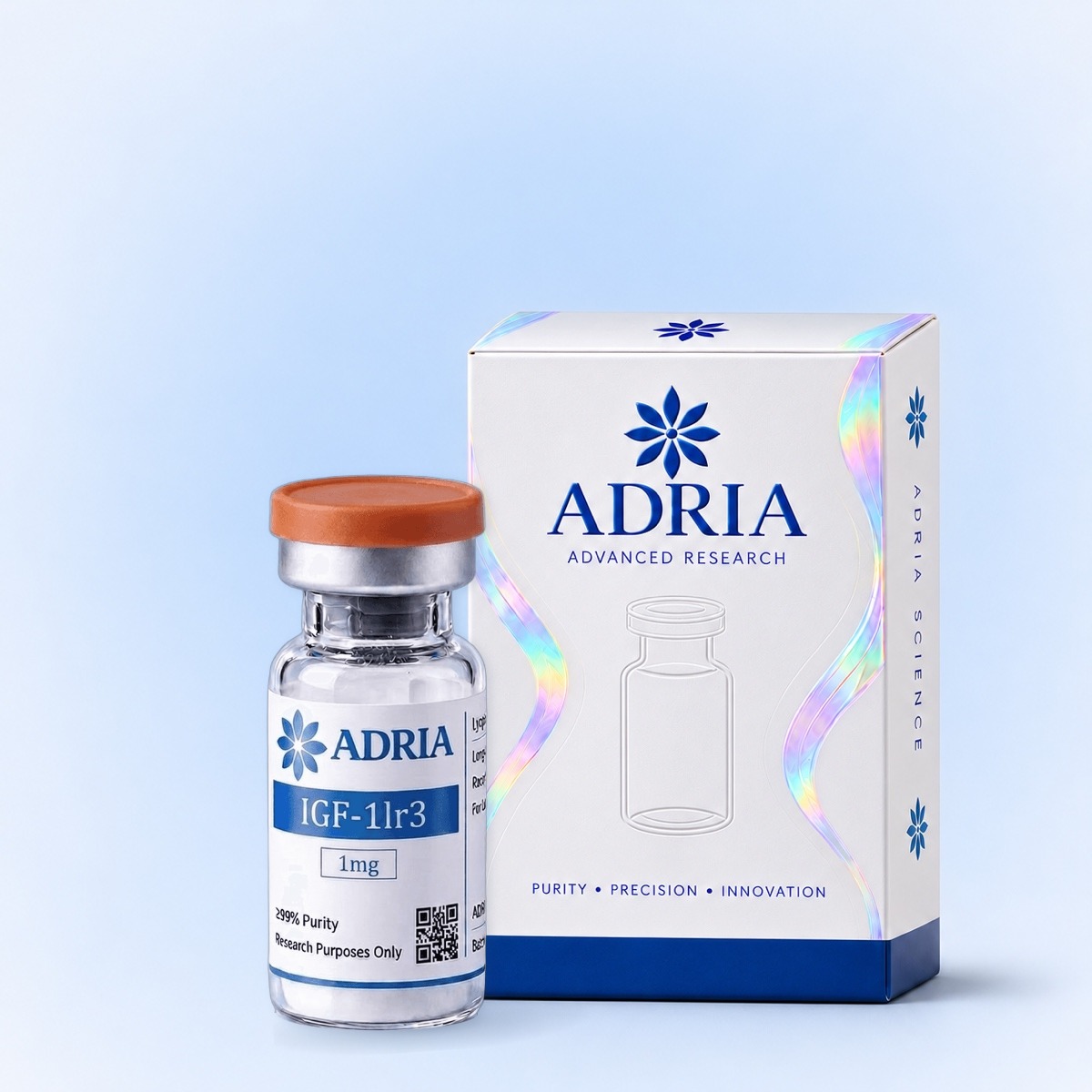
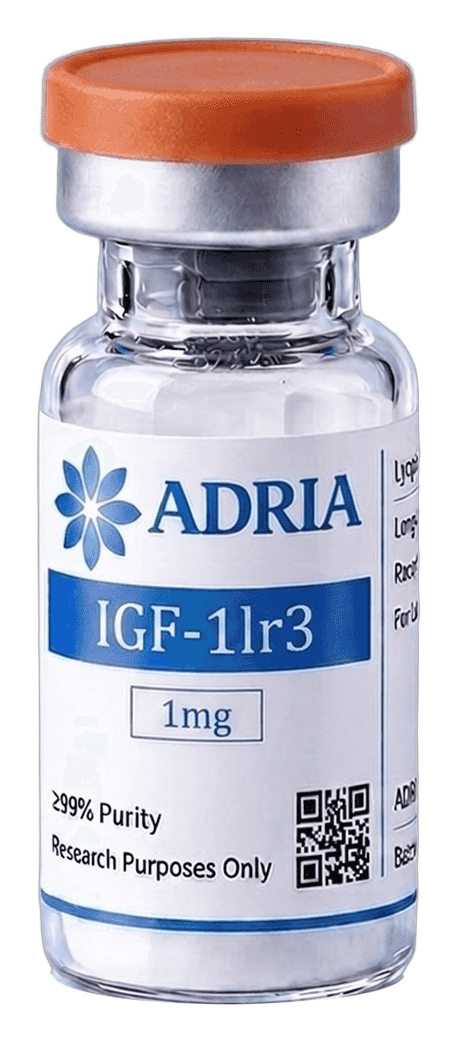
Peptide appearance
Lyophilized form helps protect peptide quality. Peptides are supplied as a dry powder, which may look like a compact "puck" or a lighter powder inside the vial.
Because the peptide is dry, it does not require refrigerated shipping during normal transit, including warm seasonal conditions. For longer storage, follow the storage guidance in the product description.
Appearance can vary. The stated peptide content is checked through third-party analysis.
Read more in the product description.
Solution not bundled
Peptides are delivered as lyophilized powder. This dry form helps preserve peptide quality during storage and transport and does not require refrigerated shipping during normal transit.
To prepare a solution, use a solvent such as Bacteriostatic water. It is sold separately, so add it only when you need it for peptide preparation.
Read more in the product description.
Muscle Growth
IGF-1 LR3
Low stock
Order within — to ship today
Arrives 26 – 30 November to Europe


 Shown at checkout
IGF-1 LR3
138,50 €
Long R3 IGF-1 analogue for IGF receptor and binding-protein interaction studies.
Compound information
Specifications
Molecular profile
- Sequence
- MFPAMPLSSLFVNGPRTLCGAELVDALQFVCGDRGFYFNKPTGYGSSSRRAPQTGIVDECCFRSCDLRRLEMYCAPLKPAKSA
- Molecular mass
- 9117.6 g/mol
- CAS number
- 143045-27-6
- Molecular formula
- C400H625N111O115S9
Material record
- Physical appearance
- White to off-white lyophilized powder
- Solubility
- Soluble in bacteriostatic water and suitable aqueous laboratory solvents.
- Product note
- Long R3 IGF-1 analogue; studied for IGF-1 receptor signalling, IGFBP interaction models, and cell-culture pathway research; supplied strictly for research use only.
Research overview
IGF-1 LR3
What is IGF-1 LR3?
IGF-1 LR3 (Long Arg3 Insulin-Like Growth Factor-1) is a synthetic analogue of human IGF-1, engineered for greater biological stability and potency.
By replacing the amino acid arginine at position 3 and extending the sequence by 13 additional amino acids, IGF-1 LR3 achieves a prolonged half-life of 20–30 hours—compared to only a few minutes for natural IGF-1.
This allows for sustained activation of IGF-1 receptors, making IGF-1 LR3 a key research peptide in studies of muscle growth, cellular regeneration, and metabolic regulation.
Ideal for growth, regeneration, and insulin-like signaling research.
Key Research Findings
- Muscle & Tissue Growth: Activates satellite cells and stimulates protein synthesis.
- Cellular Regeneration: Supports the repair of muscle, nerve, and connective tissue.
- Enhanced Nutrient Utilization: Promotes glucose uptake and amino acid transport into cells.
- Extended Half-Life: Maintains receptor activity for up to 30 hours for prolonged biological effects.
Research areas
- Protein synthesis and activation of satellite cells in skeletal-muscle models
- Proliferation and differentiation of cells in culture
- Anabolic effects and shifts in muscle fibre type in preclinical models
- Prolonged biological activity as a consequence of reduced IGFBP binding
- Tissue regeneration and wound-healing research
Detailed Mechanism of Action
Understanding the mechanism matters before you buy IGF-1 LR3, because it dictates how the peptide should be used. IGF-1 LR3 binds the type 1 IGF receptor (IGF-1R), a transmembrane receptor tyrosine kinase expressed on skeletal muscle, bone, liver, neural tissue, and most proliferating cell types. Ligand binding triggers autophosphorylation of the receptor’s beta subunits and recruitment of the docking proteins IRS-1 and Shc, from which two major signaling arms diverge.
The PI3K/Akt arm is the anabolic workhorse. Akt activates mTORC1, which phosphorylates p70S6K and 4E-BP1 to raise translational capacity, and at the same time inhibits GSK-3β and the FOXO transcription factors. FOXO suppression lowers expression of the atrophy-related ubiquitin ligases atrogin-1/MAFbx and MuRF1, which is how IGF-1 signaling simultaneously builds protein and blocks its breakdown (Stitt and colleagues, 2004).
The Ras/Raf/MEK/ERK arm drives proliferation and is the pathway most relevant to myoblast expansion and the early phase of muscle regeneration. IGF-1R signaling also phosphorylates BAD and supports Bcl-2 family survival proteins, which underlies the anti-apoptotic effects reported in cardiomyocytes, neurons, and cultured myotubes. At high concentrations IGF-1 LR3 can also engage the insulin receptor and IGF-1R/IR hybrid receptors, which is why glucose uptake must be monitored in animal work.
What sets IGF-1 LR3 apart is not receptor pharmacology but binding-protein pharmacology. In serum and in conditioned culture media, more than 95% of native IGF-1 is bound by IGFBP-1 through IGFBP-6 and is unavailable to the receptor.
The Arg3 substitution cuts IGFBP affinity to a small fraction of native IGF-1’s, so even though the analog’s affinity for IGF-1R is modestly lower, its net biological potency is higher. That is exactly why labs buy IGF-1 LR3 rather than native IGF-1 when they need a predictable, sustained IGF-1R stimulus.
Published Research
Before you buy IGF-1 LR3, it helps to know that the molecule has a 30-year peer-reviewed history. The analog was developed in Adelaide, Australia, and first characterized by Francis and colleagues (1992) in the Journal of Molecular Endocrinology.
That study produced a series of N-terminally extended IGF-1 fusion proteins and showed that the Long R3 variant, which binds IGFBPs poorly, was two to three times more potent than native IGF-1 at stimulating protein synthesis in rat L6 myoblasts. The authors concluded that escaping IGFBP sequestration matters more for potency than small changes in receptor affinity.
In the same year, Tomas and colleagues (1992) in the Biochemical Journal compared IGF-1 with its variants in dexamethasone-treated rats, a standard model of glucocorticoid-induced catabolism. The IGFBP-evading variants produced greater weight gain and nitrogen retention than native IGF-1 at equivalent doses, confirming that the in-vitro potency advantage carries over to whole-animal anabolic endpoints.
Conlon and colleagues (1995) later showed that Long R3 IGF-1 infusion in guinea pigs stimulated organ growth while lowering plasma IGF-1, IGF-II, and IGFBP levels through feedback on the GH axis. This feedback effect is worth remembering when designing in-vivo work, because systemic IGF-1 readouts can fall even while tissue-level anabolic signaling rises.
The downstream pathway was mapped by Rommel and colleagues (2001) in Nature Cell Biology, who demonstrated that IGF-1-induced hypertrophy of C2C12 myotubes depends on PI3K/Akt/mTOR and PI3K/Akt/GSK3 signaling and is abolished by rapamycin. Together these papers explain the three properties that support the decision to buy IGF-1 LR3 for growth-signaling research: a validated receptor mechanism, a potency advantage rooted in IGFBP evasion, and reproducible anabolic effects in animal models.
Why Choose IGF-1 LR3?
- IGF-1 LR3 is one of the most extensively researched growth-promoting peptides, known for its prolonged half-life, potent anabolic signaling, and regenerative properties.
- Its applications span metabolic, muscular, and cellular growth research, making it a core compound for scientists studying tissue repair and performance biology.
Order IGF-1 LR3 1 mg and take your research on cellular growth and regeneration to the next level.
For laboratory purposes and personal observation only. Not for human consumption.
Laboratory care
Handling
Peptides in transport
Peptides in lyophilized form are supplied in glass vials by standard shipping methods and do not require refrigeration. Short-term temperature fluctuations during transport will not reduce their quality and efficacy. Even at high summer temperatures, the peptides in lyophilized form are stable for several weeks.
Storage of lyophilized peptides
Lyophilized peptides should be stored in a dry place, protected from light and moisture. The following storage conditions are generally recommended:
- Room temperature (15–25 °C): Up to 3 months
- Refrigerated (2–8 °C): Up to 6 months
- Frozen (-20 °C or below): 3–5 years (recommended for long-term storage)
Allow the vial to reach room temperature after taking it out of the refrigerator or freezer.
Storage of reconstituted peptides
Once reconstituted, peptide solutions are generally less stable than their lyophilized form and should be stored under refrigerated conditions whenever possible.
The following storage conditions are generally recommended:
- Room temperature (15–25 °C): Avoid prolonged storage
- Refrigerated (2–8 °C): Typically 4–8 weeks
- Frozen (-20 °C or below): Up to 3–4 months
To preserve peptide integrity, avoid repeated freeze–thaw cycles, as these may accelerate peptide degradation.
Important: Most manufacturers recommend discarding reconstituted peptides within 4 weeks when stored at 2–8 °C. This recommendation is intentionally conservative and may not reflect the actual chemical stability of every peptide. In our own stability studies, many peptides reconstituted in bacteriostatic water showed no detectable degradation after 12 weeks of refrigerated storage. As peptide stability is highly sequence- and formulation-dependent, this result should not be extrapolated to all peptides without supporting stability data.
Analytical documentation
Tests
Latest published result
Liquilabs s.r.o.Signed Certificate of Analysis · 1mg
98.6%Purity by HPLC
Recorded QC panel
- AssayPeptide screening
- 1.064 mg
- PurityPeptide screening
- 98.6%
- Identity (FTIR)FTIR spectrum
- 994
- Identity (RT)Retention time
- 0.998
These are the latest published results for this strength. The batch number is printed on each vial. Your supplied batch is confirmed against the matching published record when your order is allocated.
Customer reviews

Quality products,fast shipping,great refferal plan,only downside is that products in 4 mounths since my first order got more and more expensive ,but overall verry good experience.
Read full review →More than 2 weeks for package dispatch. They promised one free peptide next time. Sent me new tracking number but package still wasn't delivered to fedex. Last package (much much cheaper) was delivered in less than week. I will update if they will send my package. ok,package sent.
Read full review →Extremely satisfied with the product quality and overall experience. The customer service is polite and quick. All recommendations!
Read full review →Great service!
Read full review →Always on time and customer care is super great
Read full review →Fast good, and quality is perfect
Read full review →ordered 3 times now and everything ok every time.
Read full review →Trustworthy site with a huge catalog of products. Been purchasing from them for some time now never got disappointed. I could only recommend them.
Read full review →Great quality product
Read full review →Everything was great, super customer support, honest, reliable
Read full review →Everything ok. With little problem with package, but after contact with Customer Service everything went right. Good quality of products
Read full review →Excellent. Buying peptides online can be nerve wracking! But Adria are very transparent about all the checks and certifications. My experience with them was excellent. Great products at good prices and efficient P&P
Read full review →