
Growth-hormone axis research tools
GHRP-6 and the GH Axis: Secretagogue Literature vs Exogenous GH Context
A careful GHRP-6 comparison article focused on GHS-R biology, GH-axis endpoints, somatostatin/GHRH context, and why research comparisons should avoid claims.
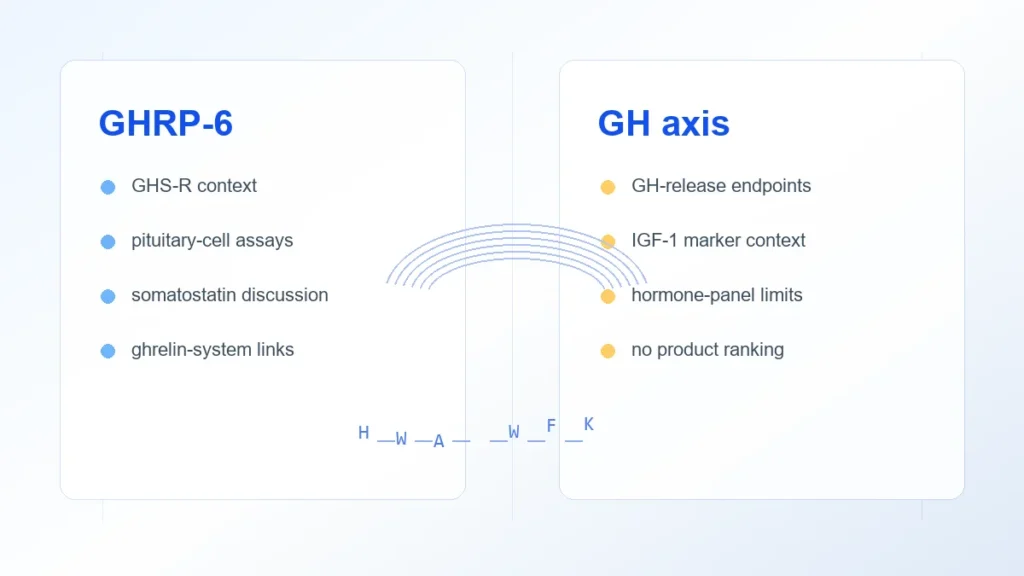
This article frames secretagogue research mechanisms as a research-use literature topic, focusing on model systems, measured endpoints, documentation context, and evidence limits.
Research context
GHRP-6 appears in early synthetic hexapeptide literature, GH secretagogue reviews, and GHS-R biology discussions. Exogenous GH and GHRP compounds belong to different research categories, so they should not be collapsed into one simple hierarchy.
The useful comparison points are GHS-R context, GHRH interaction, somatostatin discussion, GH-release endpoint, IGF-1 marker context, and hormone-panel limits.
Adria research-use note
This article is a literature overview for lawful research settings only and should not be read as practical, consumer, or applied-use guidance.
How to read this research
GHRP-6 and GH-axis comparisons should separate secretagogue receptor biology, GHRH interaction, somatostatin context, GH-release endpoint, and IGF-1 marker interpretation.
The added value is showing that exogenous GH, GHRH analogs, and GHRP compounds answer different research questions even when they share downstream markers.
Evidence checkpoints for this topic
GHRP is most useful in the archive when it is read through GHS-R or GHRH-axis signaling, hormone-panel timing, receptor context, and marker interpretation.
In this article, sources such as Early synthetic hexapeptide GH-release study, GH-releasing peptides structure and kinetics review, Growth hormone-releasing peptides and analogs review should be read for their specific methods, endpoints, and limits.
- Model: check whether the source is receptor-level work, pituitary-cell work, PK/PD modeling, endocrine marker sampling, or review-level synthesis.
- Endpoint: record GH, IGF-1, ACTH, cortisol, prolactin, cAMP, receptor activation, and sampling-window endpoints when they are reported.
- Comparator: verify the comparator compound, baseline condition, and whether repeat-exposure or desensitization is part of the study design.
- Documentation: keep sequence identity, batch traceability, COA context, storage condition, and source link together.
- Limit: keep visible the difference between a measured endocrine marker and a broad conclusion about biological effect.
What a careful reader can take from it
The practical value of this post is the structure it gives to the literature. Instead of treating every source as equal, the reader can separate the question being asked, the method used to ask it, and the claim that can reasonably follow. That is especially important in peptide topics, where online summaries often compress receptor data, model endpoints, supplier documentation, and broad interpretation into one sentence.