
Growth-hormone axis research tools
CJC-1295 + DAC Research: Albumin Binding, GHRH Analogs, and GH-Axis Context
A research-only CJC-1295 + DAC article covering albumin binding, GHRH analog design, GH/IGF-I marker studies, and the need to avoid protocol language.
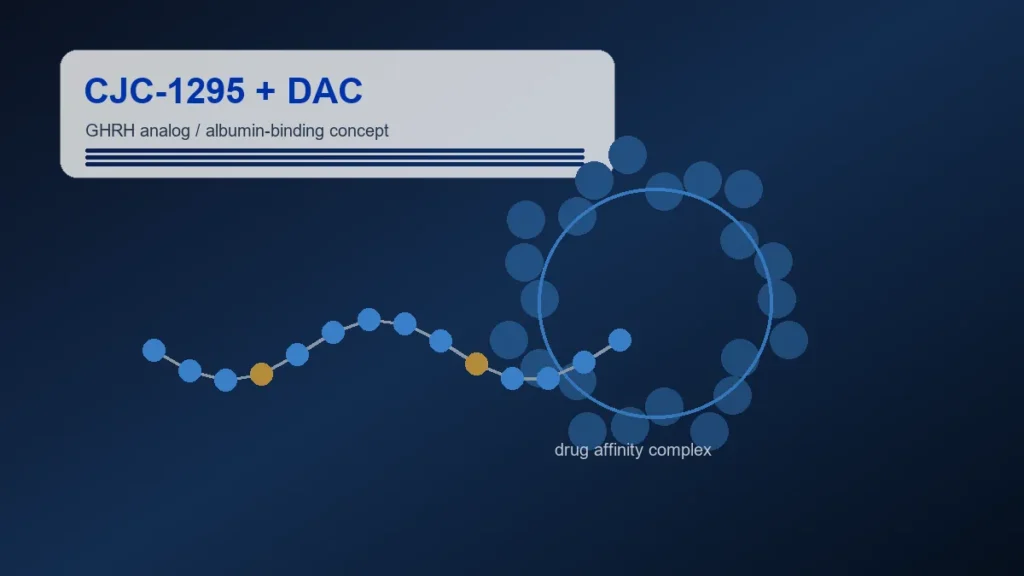
This article frames GHRH analog research and albumin-binding design as a research-use literature topic, focusing on model systems, measured endpoints, documentation context, and evidence limits.
Research context
CJC-1295 was developed as a long-acting GHRH analog using drug-affinity complex chemistry. Foundational work describes albumin bioconjugation, improved stability, and GH-axis marker studies. Later translational pharmacology literature measured GH and IGF-I responses and pulse persistence.
The correct article frame is GHRH receptor biology, albumin binding, pharmacokinetic design, GH/IGF-I markers, and model limitations. CJC-1295 with DAC should also be distinguished from shorter GHRH analogs.
Documentation context
For research materials, CJC-1295 + DAC requires exact identity, batch documentation, and clear separation between literature explanation and handling instructions.
Adria research-use note
This article is a literature overview only. It does not provide endocrine, anti-aging, performance, practical-use, practical-use, applied-use, non-laboratory-use, or non-laboratory-use guidance.
How to read this research
CJC-1295 + DAC belongs in a GHRH analog and albumin-binding design discussion. The DAC concept changes exposure in study settings, so marker timing and assay window matter.
A useful reading separates sequence class, albumin-binding rationale, GH/IGF-1 marker context, and the different evidence limits of long-acting analog papers versus short-acting secretagogue papers.
Evidence checkpoints for this topic
CJC is most useful in the archive when it is read through GHS-R or GHRH-axis signaling, hormone-panel timing, receptor context, and marker interpretation.
In this article, sources such as Identification of CJC-1295 as a long-lasting GRF analog, CJC-1295 and prolonged GH/IGF-I marker study, Pulsatile GH secretion during continuous CJC-1295 stimulation should be read for their specific methods, endpoints, and limits.
- Model: check whether the source is receptor-level work, pituitary-cell work, PK/PD modeling, endocrine marker sampling, or review-level synthesis.
- Endpoint: record GH, IGF-1, ACTH, cortisol, prolactin, cAMP, receptor activation, and sampling-window endpoints when they are reported.
- Comparator: verify the comparator compound, baseline condition, and whether repeat-exposure or desensitization is part of the study design.
- Documentation: keep sequence identity, batch traceability, COA context, storage condition, and source link together.
- Limit: keep visible the difference between a measured endocrine marker and a broad conclusion about biological effect.
What a careful reader can take from it
The practical value of this post is the structure it gives to the literature. Instead of treating every source as equal, the reader can separate the question being asked, the method used to ask it, and the claim that can reasonably follow. That is especially important in peptide topics, where online summaries often compress receptor data, model endpoints, supplier documentation, and broad interpretation into one sentence.