
Immune and neuropeptide research
Ghrelin and Immune Crosstalk: Inflammation Markers and GHS-R Context
A research-only ghrelin article focused on GHS-R signaling, inflammation markers, immune-system crosstalk, and model-specific interpretation.
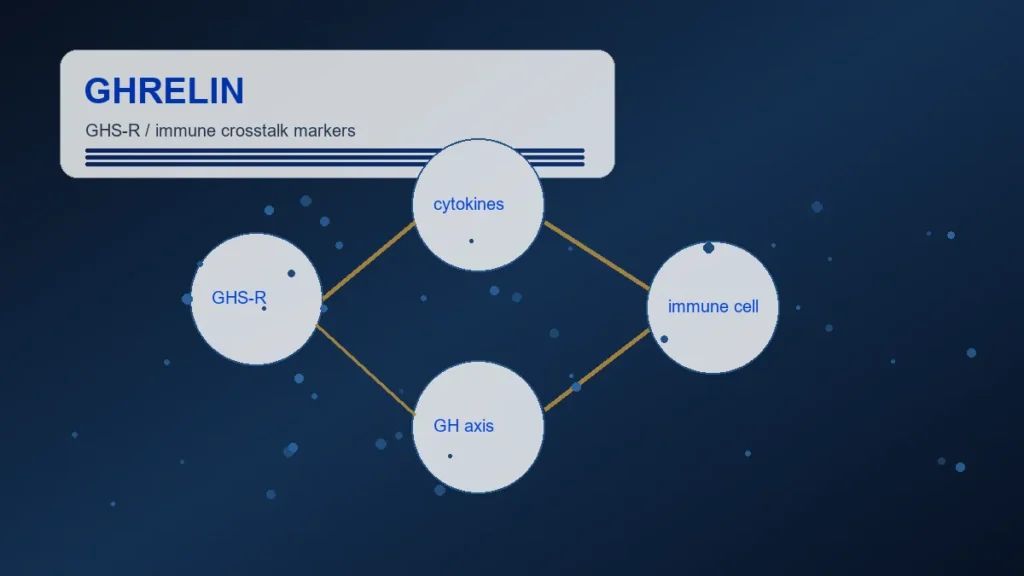
Ghrelin is often simplified as a hunger hormone, but the literature also discusses immune and inflammatory crosstalk. This article keeps the focus on mechanisms and markers.
Research context
Ghrelin is the endogenous ligand for the growth hormone secretagogue receptor. Review literature describes interactions with cytokine signaling, immune-cell activity, inflammatory stress, and endocrine feedback. Some studies also examine T-cell-derived ghrelin and age-associated inflammatory-marker changes.
The safe Adria angle is GHS-R biology, cytokine readouts, macrophage and T-cell model data, endocrine-immune signaling, and model limitations. It should not be written as a therapeutic article.
Documentation context
Ghrelin, GHRP compounds, and GHS-R ligands are not interchangeable. Literature notes should name the compound, model, endpoint, and source paper.
Adria research-use note
This article is a literature overview only. It does not provide immune, metabolic, appetite, practical-use, applied-use, non-laboratory-use, or non-laboratory-use guidance.
How to read this research
This article frames GHS-R signaling, immune-marker work, cytokine readouts, and GH-axis interpretation as a research-use literature topic, focusing on model systems, measured endpoints, documentation context, and evidence limits.
The better reading path is to ask whether the source studied receptor signaling, inflammatory markers, endocrine markers, or model-organism physiology, because each supports a different level of conclusion.
Evidence checkpoints for this topic
Ghrelin and Immune Crosstalk is most useful in the archive when it is read through GHS-R or GHRH-axis signaling, hormone-panel timing, receptor context, and marker interpretation.
In this article, sources such as The effects of ghrelin on inflammation and the immune system, T-cell-derived ghrelin and inflammatory cytokine expression, Ghrelin in metabolic disease from an immune perspective should be read for their specific methods, endpoints, and limits.
- Model: check whether the source is receptor-level work, pituitary-cell work, PK/PD modeling, endocrine marker sampling, or review-level synthesis.
- Endpoint: record GH, IGF-1, ACTH, cortisol, prolactin, cAMP, receptor activation, and sampling-window endpoints when they are reported.
- Comparator: verify the comparator compound, baseline condition, and whether repeat-exposure or desensitization is part of the study design.
- Documentation: keep sequence identity, batch traceability, COA context, storage condition, and source link together.
- Limit: keep visible the difference between a measured endocrine marker and a broad conclusion about biological effect.
What a careful reader can take from it
The practical value of this post is the structure it gives to the literature. Instead of treating every source as equal, the reader can separate the question being asked, the method used to ask it, and the claim that can reasonably follow. That is especially important in peptide topics, where online summaries often compress receptor data, model endpoints, supplier documentation, and broad interpretation into one sentence.