
Copper and matrix-material research
GHK-Cu in Research: Copper-Binding Peptide Models, Matrix Signaling, and Limits
A revised GHK-Cu article focused on copper-binding peptide literature, dermal fibroblast models, gene-data reviews, and cosmetic-claim boundaries.
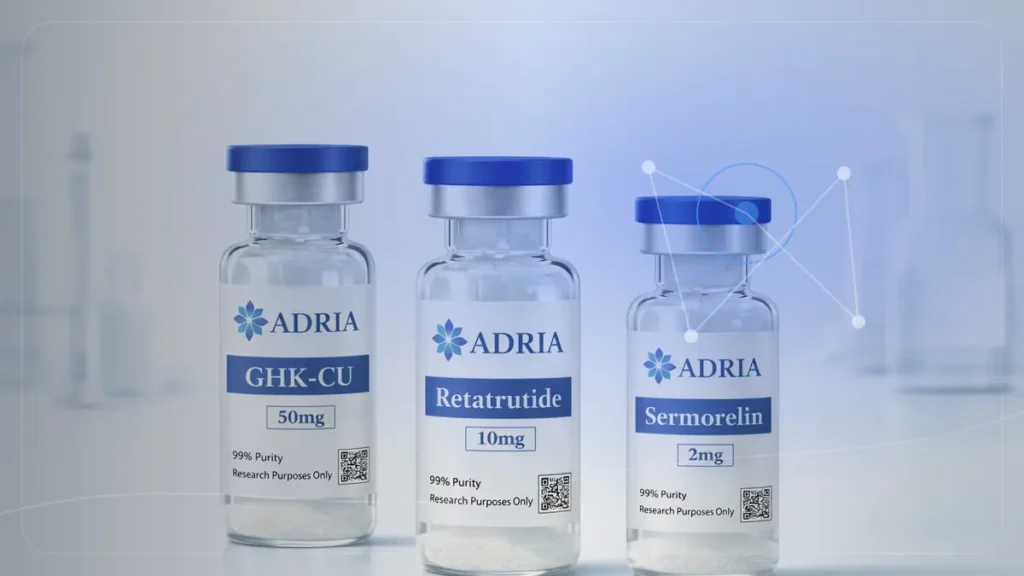
GHK-Cu is usually described as a copper-binding tripeptide complex. Because it is common in cosmetic and skin-related marketing, Adria content needs to separate research models from consumer promises.
Research context
PubMed-indexed reviews discuss GHK as a modulator of cellular pathways and consider GHK-Cu in light of gene-expression data. A dermal fibroblast paper examined GHK, GHK-Cu, and TGF-beta secretion in vitro. Broader microneedle literature is also useful when discussing peptide delivery systems, but it does not turn GHK-Cu into a cosmetic claim.
The appropriate Adria angle is copper-complex chemistry, fibroblast model work, extracellular-matrix signaling, wound-model literature, and evidence boundaries.
Documentation context
For copper peptide materials, the record should preserve identity, batch number, COA, purity context, storage guidance, and any relevant complex or salt-form information. This is more useful than broad language about skin appearance.
Adria research-use note
GHK-Cu is discussed here only for lawful analytical and R&D workflows. No cosmetic, anti-aging, wrinkle, hair, practical-use, applied-use, non-laboratory-use, or non-laboratory-use guidance is provided.
Evidence checkpoints for this topic
GHK is most useful in the archive when it is read through analytical documentation, peptide identity, storage, formulation, purification, and traceability.
In this article, sources such as GHK peptide as a modulator of multiple cellular pathways, GHK-Cu and gene-data review, GHK and GHK-Cu effects on TGF-beta secretion in dermal fibroblasts should be read for their specific methods, endpoints, and limits.
- Model: check the material record: sequence, batch number, analytical method, storage condition, excipient context, and handling window.
- Endpoint: record identity confirmation, purity profile, HPLC/LC-MS style documentation, formulation notes, stability risk, and chain-of-custody records.
- Comparator: verify whether a statement is based on supplier documentation, analytical method, shipping condition, or a literature source.
- Documentation: keep sequence identity, batch traceability, COA context, storage condition, and source link together.
- Limit: keep visible why procurement and documentation articles should be operationally specific instead of promotional.
What a careful reader can take from it
The practical value of this post is the structure it gives to the literature. Instead of treating every source as equal, the reader can separate the question being asked, the method used to ask it, and the claim that can reasonably follow. That is especially important in peptide topics, where online summaries often compress receptor data, model endpoints, supplier documentation, and broad interpretation into one sentence.