
COA and batch documentation
Research Peptide Quality: COA Transparency, HPLC Context, and Batch Traceability
A documentation-first view of research peptide quality, focusing on COA traceability, analytical methods, and why unsupported purity claims are not enough.
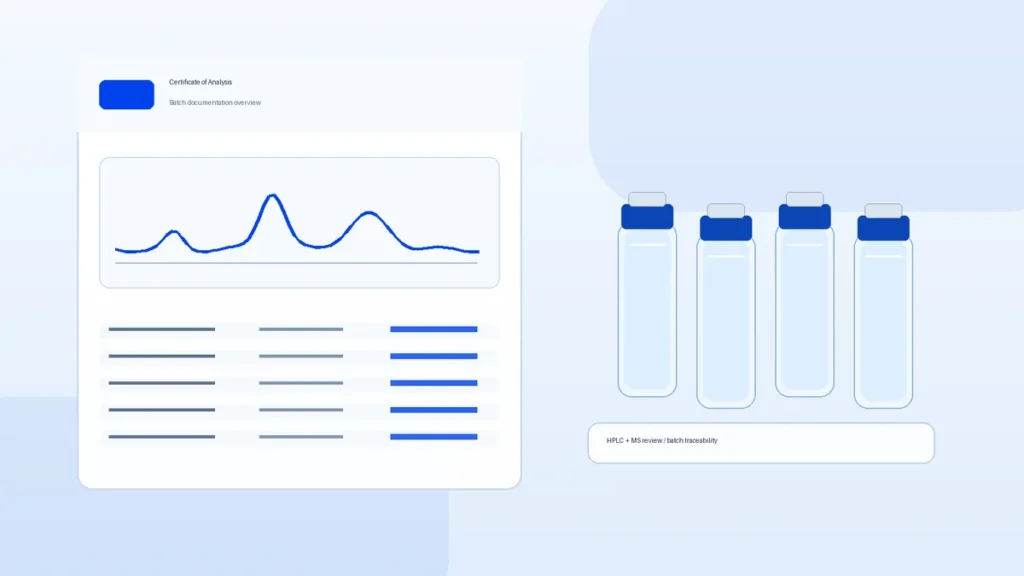
Research peptide quality is not proven by a number on a product card. A purity percentage only becomes useful when it is connected to a batch, an analytical method, and a document that can be reviewed.
What COA transparency should show
A practical COA should help a researcher answer basic questions: which product was tested, which batch or lot does the document cover, what method was used, what result was reported, and whether identity confirmation is available. For peptide materials, HPLC-style purity data and mass confirmation are common parts of the documentation discussion, but the actual document must still be read carefully.
ICH Q2(R2), available through FDA and EMA publications, is a useful framework for thinking about analytical procedure validation. It does not mean every research supplier is operating under a medicine-authorization system, and Adria does not present it that way. The value is conceptual: serious analytical data requires method suitability, defined parameters, and traceability.
Why batch traceability matters
Two vials with the same product name may come from different synthesis runs, different analytical records, or different storage histories. Batch traceability connects the material to the documentation, and documentation connects the product to a reproducible research record. Without that connection, quality language becomes marketing rather than evidence.
Adria position
Use our guides to verify a peptide COA, understand HPLC purity, and review endotoxin testing alongside the matching batch record. Adria Science products are for laboratory research only.
Evidence checkpoints for this topic
Research Peptide Quality is most useful in the archive when it is read through analytical documentation, peptide identity, storage, formulation, purification, and traceability.
In this article, sources such as FDA: ICH Q2(R2) Validation of Analytical Procedures, EMA: ICH Q2(R2) scientific guideline, WHO: Substandard and falsified medical products should be read for their specific methods, endpoints, and limits.
- Model: check the material record: sequence, batch number, analytical method, storage condition, excipient context, and handling window.
- Endpoint: record identity confirmation, purity profile, HPLC/LC-MS style documentation, formulation notes, stability risk, and chain-of-custody records.
- Comparator: verify whether a statement is based on supplier documentation, analytical method, shipping condition, or a literature source.
- Documentation: keep sequence identity, batch traceability, COA context, storage condition, and source link together.
- Limit: keep visible why procurement and documentation articles should be operationally specific instead of promotional.
What a careful reader can take from it
The practical value of this post is the structure it gives to the literature. Instead of treating every source as equal, the reader can separate the question being asked, the method used to ask it, and the claim that can reasonably follow. That is especially important in peptide topics, where online summaries often compress receptor data, model endpoints, supplier documentation, and broad interpretation into one sentence.