
About Adria Science
Built for research.
Built on trust.
We started as a small business with a simple ambition: make sourcing research peptides more dependable. Today, Adria Science is chosen by more than 15,019 returning customers.
From manufacturing and independent testing to documentation, fulfilment and support, we pay attention to the entire experience. You should know what you’re ordering, where to find the evidence and who to contact when you need an answer.

Our story
A small beginning.
A clearer way forward.

Adria Science began with a frustration: sourcing research peptides could involve too much uncertainty. Inconsistent quality, missing documents and reports that could not be independently verified made it difficult to judge what was actually being offered.
We wanted to build the kind of supplier we would feel comfortable relying on ourselves. That meant looking at the whole process: how the peptides are made, how a batch is tested, how the results are documented and how an order is handled.
So we started small and built around those priorities. Careful sourcing, independent laboratory work, clear product information and reachable support became the foundation of Adria Science.
We have spent a long time working through the practical details, trying and refining the experience from sourcing and documentation to packing, dispatch and support. The aim has always been to make the whole journey dependable, right through to the person receiving the order.
We have grown, but the reason we started has stayed the same. Whether you are comparing products for a new project or returning to something familiar, we want your next order to feel informed, straightforward and well supported.
Manufacturing context
Quality begins
before the finished vial.
Our peptides are produced using solid-phase synthesis by a manufacturer inspected by the FDA, NMPA, EMA, TGA and MFDA, and compliant with cGMP, ISO 9001 and ISO 13485 standards.
Each batch of peptides undergoes rigorous blind and independent third-party testing across multiple laboratories. This connects the manufacturing process with analytical verification and gives our research peptide range a documented basis for review.
For us, manufacturing and testing belong in the same conversation. The production process establishes the starting point; independent analysis provides information about the batch itself. Product identity, batch numbers, analytical methods and measured results help you assess the material in front of you.
That is the approach behind our quality standard: care in production, scrutiny through testing and documentation that researchers can actually use. We bring those elements together across our range, with product-specific reports available through the Test Results Library.
- 01Solid-phase synthesis
- 02Independent analysis
- 03Batch documentation
Quality you can review
Look closer.
The details are there.
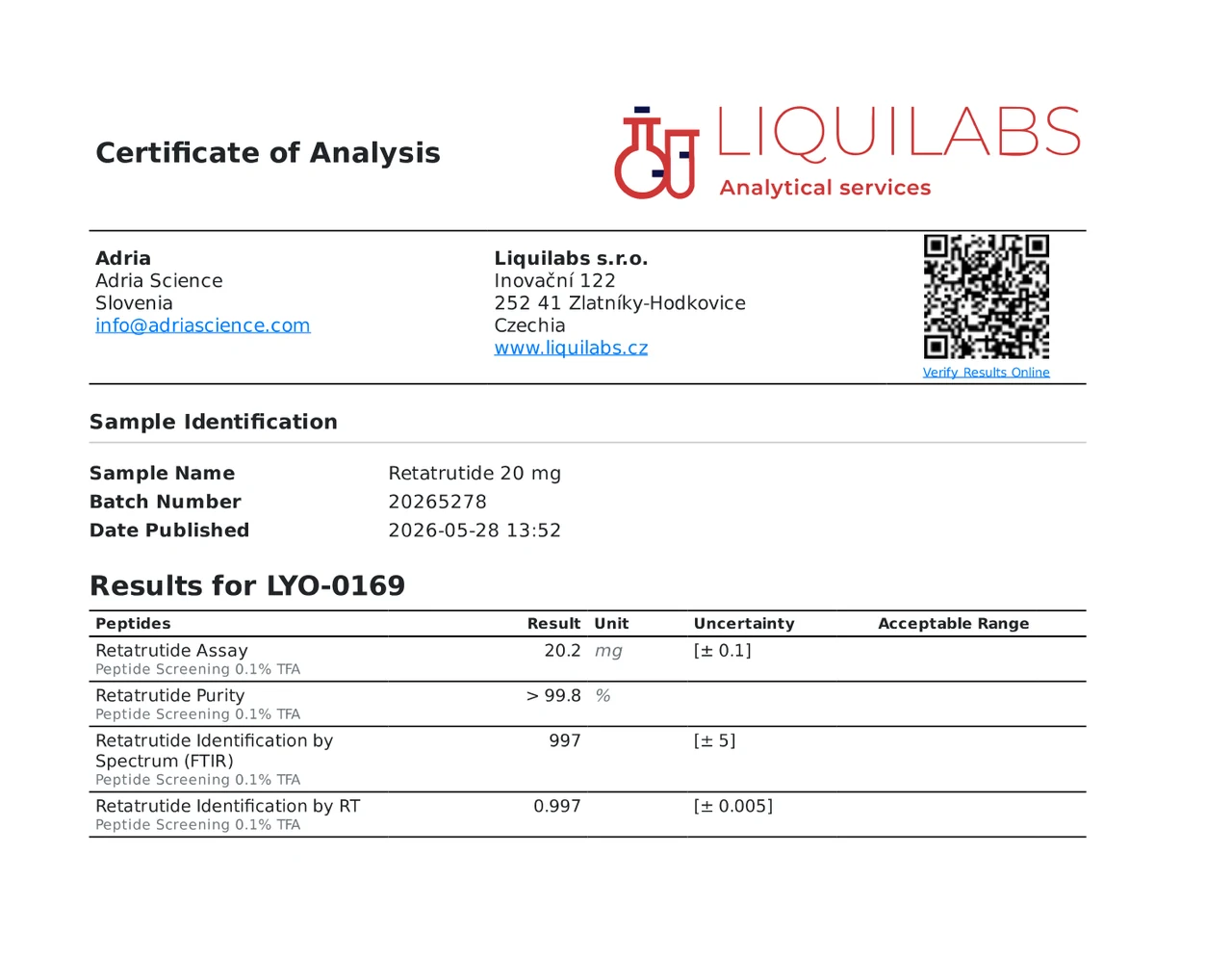
A Certificate of Analysis connects a named product and batch to a laboratory’s findings. Our library lets you review the available reports before ordering and return to them when you need the details.
Identity, content, purity and additional laboratory checks each answer a different question. Open the topics below to see what the methods tell you, how to read the results and why they matter when comparing research materials.
The matching report confirms which analyses were performed, their methods and results. The guide below explains the different checks; it does not replace the scope stated in that report.
Identity & molecular confirmationLC-MS / mass spectrometry
LC-MS / mass spectrometry
Identity testing addresses the first question: does the analysed material match the named peptide? Mass spectrometry provides molecular-mass information, often alongside chromatographic separation. The laboratory’s reported identification should correspond to the product and batch you are reviewing.
How to read it
Look for the sample name, identification result and method. For blends, check which components the report identifies; a result for one component does not describe the whole mixture.
Find your batch reportPeptide content & label amountQuantitative content assay
Quantitative content assay
A content assay measures the amount of the target peptide in the submitted sample. It answers a different question from chromatographic purity: how much of the named material was measured? Read the reported amount and units against the product’s labelled quantity.
How to read it
Check whether the result is expressed per vial, per sample or as a concentration. Where the laboratory provides uncertainty or an acceptance range, read that alongside the measured value.
Find your batch reportPurity & impurity profileRP-HPLC / chromatographic analysis
RP-HPLC / chromatographic analysis
Chromatography separates components so the laboratory can assess the main peptide signal and related peaks. The reported purity belongs to that method and sample. An impurity profile can also help identify synthesis-related or degradation-related components.
How to read it
Read the purity result together with the chromatogram and method where provided. Purity percentage, identity and peptide content are separate pieces of information, so review all three rather than relying on a single headline number.
Find your batch reportMicrobiology & sterility checksBioburden / report-specific testing
Bioburden / report-specific testing
Microbiological analysis can measure aerobic microorganisms, yeasts and moulds. Sterility testing is a separate assessment. When these analyses are included, the report identifies the test performed and its findings.
How to read it
Check the method, units and acceptance criteria. A bioburden result should not be read as a sterility claim.
Find your batch reportBacterial endotoxinsEndotoxin assay
Endotoxin assay
Endotoxin analysis checks for bacterial endotoxins, which can affect laboratory work. It is distinct from counting live microorganisms. The corresponding report states the method, result and applicable limit.
How to read it
Read the units and reporting limit alongside the result. Use the matching batch document to confirm whether this analysis was performed.
Find your batch reportHeavy metals & elemental impuritiesICP-MS / AAS where reported
ICP-MS / AAS where reported
Elemental analysis can measure trace metals such as lead, cadmium, arsenic and mercury. The report identifies the elements assessed, the measured amounts and any stated limits.
How to read it
Check each listed element and its units. The scope is the panel actually analysed, so a result for one element does not cover every possible contaminant.
Find your batch reportStability, storage & handlingProduct-specific conditions
Product-specific conditions
Stability concerns how material changes over time under stated conditions. A meaningful stability result needs that context: the product form, storage conditions, time points and analyses used. A single purity report is a snapshot of the tested sample.
How to read it
Follow the product’s storage and handling information. Where stability data are supplied, check their conditions and duration before applying them to your own laboratory workflow. Contact us if you need help finding those details.
Find your batch reportTraceable batches & consistencyLot records / independent verification
Lot records / independent verification
A useful batch record links the product and lot number to an issuing laboratory, report date and analytical findings. To compare batches, review the same measurements and methods across their respective reports. A previous batch’s result does not replace the current batch’s record.
How to read it
Match the lot on your product, open its report and use the laboratory’s verification link or QR code where provided. Send us the product and batch details if you cannot find the matching record.
Find your batch reportSafety documents & research handlingMSDS / Safety Data Sheet
MSDS / Safety Data Sheet
Safety documentation serves a different purpose from a Certificate of Analysis. It supports handling, storage and other practical precautions; the COA records the laboratory findings for a sample or batch. Both can be relevant when planning your research workflow.
How to read it
Review the product information and available MSDS or Safety Data Sheet together. If a document needs clarification, our team can help locate the relevant record and answer product-specific questions.
Find your batch reportFrom order to delivery
Care in every step.
Support all the way.
We have put time into refining how an order moves from our hands to yours. Product information, careful preparation, secure packaging, the delivery route and responsive support all belong to the same experience.
Research peptides need thoughtful handling and clear records. Our fulfilment approach brings those practical details together, so you can review the available shipping options and know where to turn for help throughout the journey.
Same-day fulfilment
Eligible paid orders for in-stock products, confirmed before the daily dispatch cut-off, are prepared for dispatch the same business day.
Preorders, review requirements and non-working days can affect the dispatch date.
Protected shipping
Orders are carefully packed for transport. Shipment protection is available through the shipping-protection option, with eligible loss or damage handled under the applicable policy.
Coverage follows the protection selected and its conditions.
Tracking & order updates
Tracking details are shared when issued, so you can follow the shipment after dispatch. If an update needs explaining, our team can help you check the order.
People you can reach
Ask us about product details, documentation, availability, payments or delivery. Include the product and batch, or your order number, so we can give you a relevant answer.
Secure, discreet packaging
Research vials are handled carefully and protected for transport. Orders use a plain outer package, keeping product names and branding off the outside while retaining required carrier or customs information.
On arrival, follow the storage guidance for your specific product. Contact us promptly if the parcel or its contents appear damaged.
EU delivery & customs support
Goods in free circulation moving within the EU customs territory do not incur import customs duties between member states. This makes eligible intra-EU deliveries more straightforward.
Other destinations and special territories follow their own requirements. Available services depend on the destination; our team can help with the shipping options and order documents.
A clear route from checkout to arrival.
Review the delivery services offered for your address at checkout. If you are unsure about a destination, a carrier option or the documents you need, contact us before ordering and we can help you check the details. International customs decisions and any import charges remain subject to the destination’s rules.
Once dispatched, keep the tracking details and order reference together. If a delivery is delayed, a tracking event is unclear or a parcel arrives damaged, send us the relevant information so our team can review it and explain the next steps.

Independent verification
Your own testing
is welcome.
Independent scrutiny is part of the standard we want to uphold. We welcome researchers and companies who choose to have our products analysed by a qualified third-party laboratory.
If you have commissioned testing, send us the complete report with the product identity and batch details. Our team reviews the document and its context before confirming the next steps.
You can also contact us to discuss eligibility for ADRIA Credits. Any credit or remedy follows review and the applicable terms; submitting a report does not automatically establish a claim.
- 1Use a qualified independent laboratory.
- 2Send the complete report and batch details.
- 3Receive a reviewed response from our team.
The next step in your research
Join 15,019+ returning customers.
Explore the research peptide range, compare the product details and review the available evidence. When you need more information, we’re here to help.
Research use only. Products are supplied for laboratory, analytical, educational and R&D purposes. Not for human or animal use. Terms of sale.